
Best Montessori Toys for 1 Year Olds in Australia
The most useful toys at one are simple enough to understand, satisfying enough to repeat and challenging enough to grow with the child. This guide compares eight real options for posting, stacking, matching and movement, with clear notes on when each one makes sense.
Affiliate disclosure: This article contains Amazon affiliate links. If you buy through an eligible link, ToyBloom may earn a commission at no extra cost to you. Product availability, age guidance and included parts can change, so check the current listing and packaging before purchase.
What makes a good Montessori toy for a 1 year old?
A strong choice presents one understandable action: put in, take out, stack, match, push or ride. The child should create the result through movement rather than watch the toy perform. That does not mean every toy must be wooden, silent or sold with the word Montessori. It means the activity is hands-on, purposeful and suitable for independent attempts with an adult nearby.
“One year old” covers a wide developmental span. A child who has just turned one may still prefer emptying and filling. Several months later, the same child may be matching shapes, carrying objects and walking confidently. Choose for the skill you can see now, then offer one small next step.
Early one
Common interests: grasping, dropping, retrieving, nesting and pulling to stand.
- Stacking cups
- Large posting pieces
- Simple containers
Growing control
Common interests: deliberate release, matching, turning and repeated cause and effect.
- Simple sorters
- Posting banks
- Push toys on level floors
Confident mover
Common interests: carrying, climbing on and off low toys, steering and pretend play.
- Stable ride-ons
- Rockers
- Multi-use activity toys
If your child is not yet one, the 6 to 12 month Montessori toy guide is the closer match. For the next stage, see the guide for 2 year olds.
Purposeful play around age one
Three play actions to look for
Post and retrieve
Let the child release one large piece, find it and repeat.
Stack and knock down
The building is useful. The joyful demolition is useful too.
Push with control
Use a clear, level area and stay close while balance develops.
Which toy fits which stage?
| Pick | Best for | Most useful when | Adult check |
|---|---|---|---|
| Smart Stages Piggy Bank | Posting and songs | From the listed 6+ months | Check coin size and battery door |
| 10-Piece Stacking Cups | Nesting, stacking, bath play | Early one | Dry fully after water play |
| Wooden Colour and Shape Sorter | Matching and hand control | From the listed 12+ months | Count pieces before and after play |
| Peekaboo Learning Farm | Containers, animals, early counting | From the listed 18+ months | Wait for the marked age |
| Wooden Push Walker | Supported pushing and activity play | When pulling to stand | Test speed and tip resistance |
| 5-in-1 Rocking Horse | Rocking, balance and active play | From the listed 1+ years | Check every lock after conversion |
| Scuttlebug Beetle | Foot-to-floor movement | Confident walker | Level surface and footwear |
| VTech Push & Ride Train | Ride-on and electronic activity play | Use listed age guidance | Check batteries and detachable parts |
8 Montessori-aligned toys for one-year-olds
These are not all formal Montessori materials. They were selected because each can support a clear, child-led action. The right pick is the one that suits the child’s current ability, available play space and the age guidance on the product.
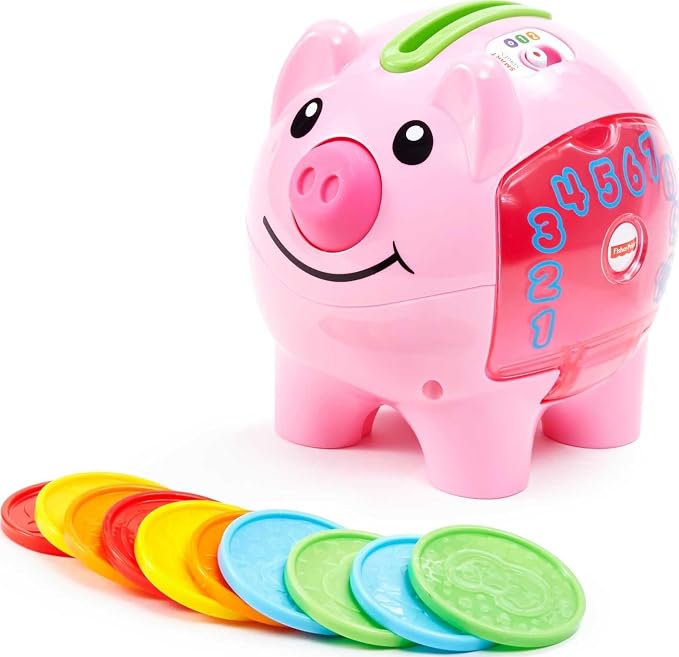
Fisher-Price Laugh & Learn Smart Stages Piggy Bank
Posting is a wonderfully clear early challenge: hold a large coin, aim for the slot, release it, open the door and begin again. This piggy bank adds songs and phrases, so it suits families who want a familiar electronic toy while still keeping a hands-on action at the centre of play.
For a calmer session, switch the sound off if the current model allows it and offer only two or three coins. Fewer pieces make the goal easier to see and reduce the temptation to scatter everything at once.
- Immediate cause and effect
- Door encourages retrieval and repetition
- Useful bridge between simple containers and narrower posting toys
Check first: Confirm every coin is too large to be a choking hazard, inspect the battery compartment and follow the current package age marking.
Check on AmazonAffiliate link. Price and availability may change.
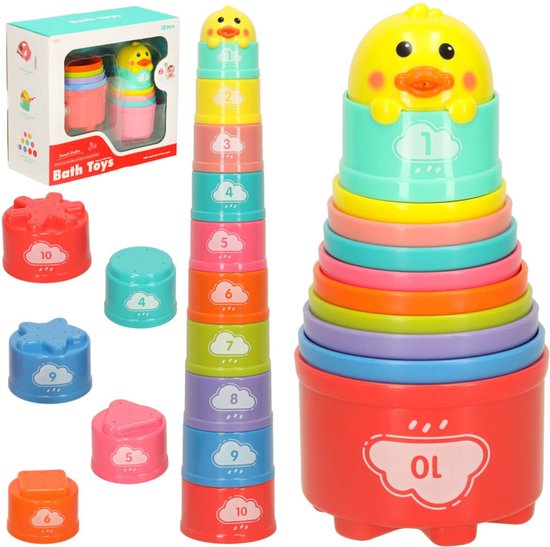
10-Piece Stacking Cups
Stacking cups earn their shelf space because one set supports many levels of play. A new one-year-old can bang two cups together, hide a small safe object beneath one or place a cup inside another. Later, the child can build a tower, compare sizes, pour water and use the cups in pretend play.
They also demonstrate a useful principle: a toy does not need a long feature list to stay interesting. The child changes the activity as coordination and imagination grow.
- Open-ended and easy to rotate into play
- Supports size comparison without requiring perfect ordering
- Can be used for filling and pouring under supervision
Check first: Inspect rims for cracks. After water play, drain and dry every cup completely to reduce trapped moisture.
Check on AmazonAffiliate link. Price and availability may change.
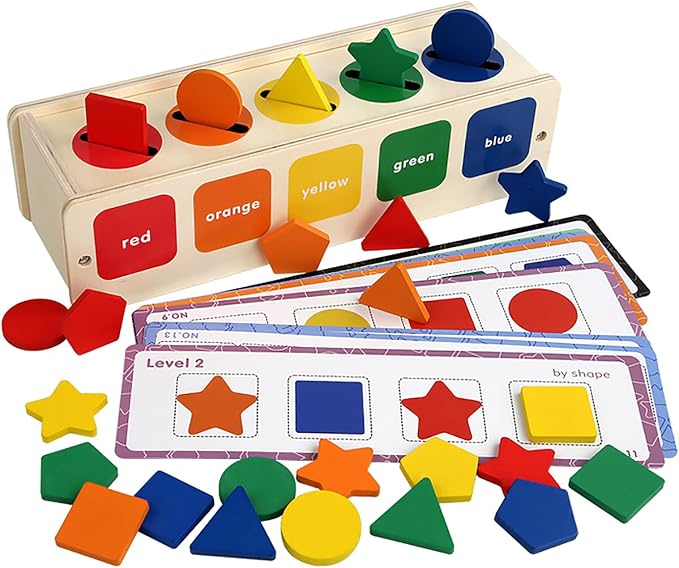
Montessori Wooden Colour and Shape Sorting Toy
This sorter introduces matching, rotation and controlled placement. At first, an adult can offer one shape beside its matching position. As the child becomes more accurate, add another choice. That gradual setup keeps the activity achievable without doing the task for them.
Do not expect correct sorting immediately. Picking up, transferring and removing pieces are meaningful stages of play too. For a deeper comparison of this category, use ToyBloom’s colour sorting toy guide.
- Can be simplified by offering fewer pieces
- Invites colour and shape language naturally
- Supports hand-eye coordination and wrist turning
Check first: Count all pieces, inspect the finish and confirm each component meets the product’s stated age and size requirements.
Check on AmazonAffiliate link. Price and availability may change.
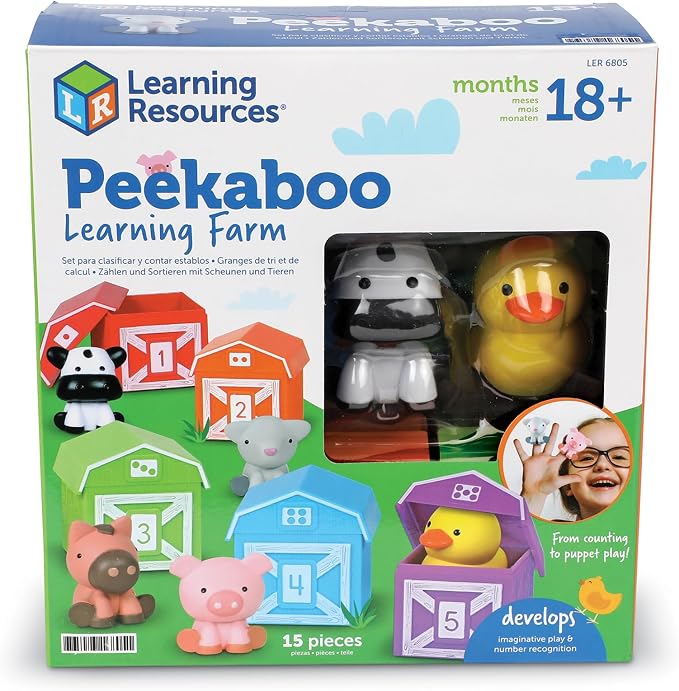
Learning Resources Peekaboo Learning Farm
This set combines opening, hiding, retrieving and matching with friendly farm animals. It is most relevant in the later part of the one-year-old stage because the supplied product title lists it for 18 months and over. That makes it an option to grow into, not a reason to rush the child ahead.
Start with one animal and one barn. Hide the animal, pause, then let the child discover it. Later, add simple words such as “in,” “out,” “open” and the animal sound. This keeps language connected to an action the child can see.
- Strong container and object permanence play
- Easy to divide into a smaller invitation
- Supports simple animal naming and pretend play later
Check first: Keep it stored until the child reaches the listed age, and inspect every animal and barn for damage before use.
Check on AmazonAffiliate link. Price and availability may change.

Wooden Push Walker Activity Toy
A push-from-behind walker can provide a movable surface for a child who is already pulling to stand and beginning to step. It does not teach walking by itself, and it is not the same as a seated baby walker. The important questions are stability, speed and whether the child can stay upright without being pulled forward by the toy.
Test it first on the actual floor. A walker that feels controlled on carpet may move quickly on tiles or timber. Clear a short route, block stairs and stay within arm’s reach.
- Combines gross-motor practice with front-panel activities
- Can encourage purposeful movement across a short space
- Wooden frame may provide useful weight when well designed
Check first: Test wheel resistance, handle security and tip stability. Never use near stairs, steps, pools, heaters or traffic areas.
Check on AmazonAffiliate link. Price and availability may change.

5-in-1 Rocking Horse for Toddlers
This convertible design is intended to shift between several kinds of active play. That can be useful in a home that has room for one larger toy rather than several separate pieces. For a young one-year-old, the value is not the number of modes. It is whether one correctly assembled mode offers a stable, understandable movement.
Introduce only one setup at a time. Recheck the instructions whenever the toy is converted, and put unused fittings out of reach. A multi-use product is only as safe as its current assembly.
- Several movement modes in one product
- Can adapt as balance develops
- Suitable for families wanting an active-play centrepiece
Check first: Confirm every fastener and conversion lock is secure, use only the mode approved for the child’s stage and keep the play zone clear.
Check on AmazonAffiliate link. Price and availability may change.
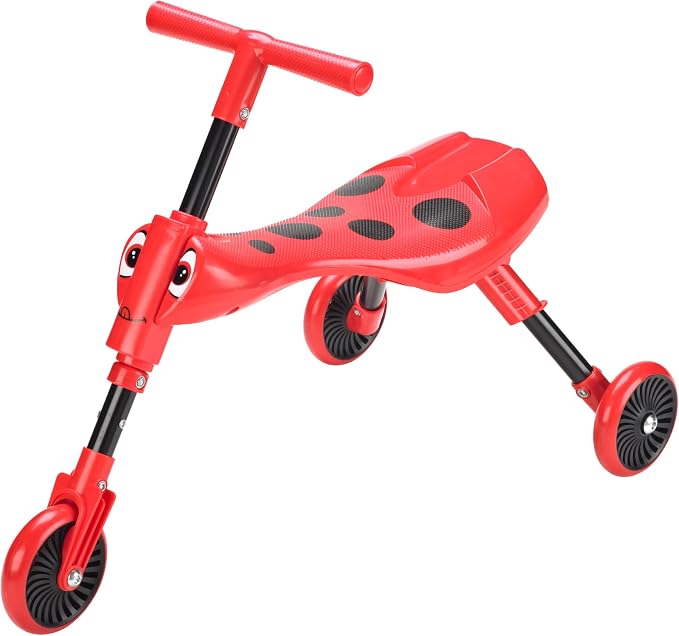
Scuttlebug Beetle Three-Wheel Ride-On
A foot-to-floor ride-on asks the child to climb on, stabilise the body and push against the floor. That makes it a better match for a confident walker than for a child who has only just begun standing. The three-wheel layout and folding design make this option compact, but the child still needs enough control to stop, turn and dismount.
Begin slowly on a flat, uncluttered surface. If the child cannot sit securely with both feet reaching the floor, put it away and try again later. See more styles in the toddler ride-on toy guide.
- Uses leg power rather than a motor
- Compact format for smaller spaces
- Invites steering and start-stop control
Check first: Inspect folding locks and wheels, use closed-toe footwear and keep away from slopes, steps, roads and water.
Check on AmazonAffiliate link. Price and availability may change.
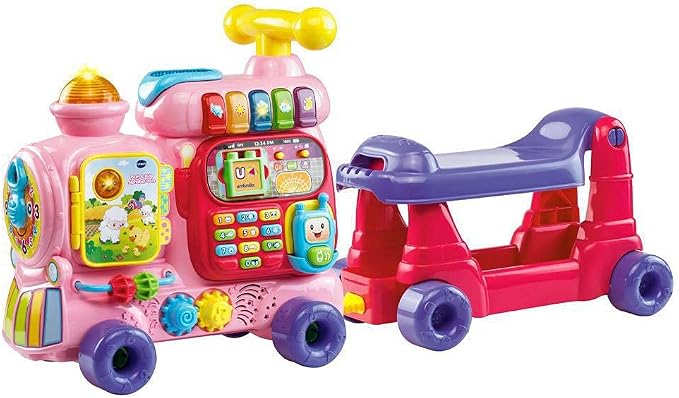
VTech Push & Ride Alphabet Train
This is the busiest toy in the guide, combining ride-on movement, push play and electronic activities. It is not a minimalist Montessori material, but it can still support child-led actions when adults limit the setup. For example, focus on pushing blocks, opening a panel or riding, rather than activating every feature at once.
Because models and regional listings can differ, check the current age recommendation, included pieces and assembly information before buying. If your goal is a quieter fine-motor activity, compare it with ToyBloom’s busy board guide.
- Multiple play modes for children who enjoy variety
- Combines movement and hand activities
- Can be simplified by presenting one action at a time
Check first: Verify the age marking, battery compartment, detachable block size, seat and handle assembly on the exact model supplied.
Check on AmazonAffiliate link. Price and availability may change.
What we looked for
The shortlist balances different types of play rather than ranking eight near-identical toys. Each option was assessed against four practical questions.
The bars show the order of editorial priority, not scientific scores or product test results.
We prioritised age guidance and safety information first, then whether the child can understand and repeat the central action. We did not assign durability scores because the products were not laboratory tested by ToyBloom. For more background on the approach, read what Montessori toys are and the guide to fine-motor toys.
Australian toy safety checklist
The Australian Competition and Consumer Commission advises adults to choose toys suited to the child’s age, read labels, check construction and remove damaged toys. Australia also has a mandatory standard for toys intended for children up to and including 36 months, covering hazards such as small parts and aspects of design and construction.
Read the ACCC kids’ toys safety guide and the Australian mandatory standard overview for toys up to 36 months. If a toy contains magnets, also review the ACCC magnet safety guidance.
A simple one-year-old toy rotation
You do not need all eight products. A small, varied shelf is easier to scan and can make repeat play more likely. Try this four-part mix:
- One posting or container activity, such as the piggy bank.
- One building activity, such as stacking cups.
- One matching activity, offered only when it is not frustrating.
- One movement toy, stored separately and used in a clear supervised space.
Rotate when interest has genuinely faded, not on a rigid timetable. A toy that is being repeated with concentration does not need to disappear. For a fuller system, see the Montessori toy rotation guide. You can also add inexpensive household play from the screen-free toddler play ideas.
Questions about toys for one-year-olds
What is the best first Montessori-style toy at age one?
For many children, stacking cups are the safest simple starting point because they support grasping, nesting, filling and tower play. A large-piece posting toy is another strong option when the child enjoys putting objects into containers. The best choice still depends on the current age marking and the child’s abilities.
Do Montessori toys have to be wooden?
No. Material matters less than the quality of the play invitation. A plastic cup that a child can stack, nest and pour may offer more independent exploration than a complicated wooden toy. Inspect any material for damage and follow its care instructions.
How many toys should a one-year-old have out?
There is no required number. Four to six varied activities are often enough for a usable shelf: one container activity, one stacking toy, one matching or fine-motor option, one movement opportunity and a couple of books or open-ended objects.
Are electronic toys Montessori?
Traditional Montessori materials are generally simple and self-correcting, so a feature-heavy electronic toy is not a classic Montessori material. It can still be used intentionally by reducing distractions and focusing on one child-led action.
Is a push walker suitable for every one-year-old?
No. It is most appropriate when the child can pull to stand and control the toy without being dragged forward. Test speed and stability on the actual floor, supervise closely and keep it far from stairs and other hazards.
What should I buy for an 18-month-old?
At 18 months, many children are ready for more deliberate matching, simple pretend play, containers with figures and stable foot-to-floor movement. Use the individual product age marking rather than treating all children of the same age as having identical skills.
Sources used for this guide
- Australian Competition and Consumer Commission: Kids’ toys guide
- Product Safety Australia: Mandatory standard for toys for children up to and including 36 months
- Product Safety Australia: Toys that have magnets guide
- American Academy of Pediatrics: Selecting Appropriate Toys for Young Children in the Digital Era
Choose the next useful challenge
Start with what the child can do today. Add one small challenge, keep the setup clear and allow plenty of repetition. A modest toy used deeply is more valuable than a crowded shelf of features.
Compare the eight picks