
Best Montessori Gifts Under $100 in Australia
A $50 to $100 budget can open up larger sets, smoother mechanisms, more useful pieces and better storage. But a higher price does not automatically mean better development, better materials or better play. The goal is to spend the extra budget on features the child will actually use.

Pay more only when you get more useful play
The sweet spot is not a scientific price threshold. It is simply the point where some products become larger, more durable or more versatile.
Smoother latches, more secure fasteners and fewer weak joints can justify a higher price.
A larger bead set or construction kit can add variety when the pieces remain age-appropriate.
A tray, chest or workbench that keeps the activity complete can make repeat use easier.
An activity that can be simplified now and made more complex later may offer better value.
Choose the activity before the product
These eight gifts cover different ages and styles of play, so start with what the child currently enjoys doing.
Track and repeat
A ball tracker gives a clear release, follow and retrieve sequence.
Match and arrange
Puzzles and logic games ask children to compare shape, position and orientation.
Build and balance
Pattern blocks and balancing pieces support planning, testing and another try.
Sort and construct
Counters and interlocking blocks can support both structured and open-ended play.
Move from simple actions to multi-step tool play
These are broad activity suggestions, not fixed milestones. Always use the exact product’s age guidance.
Grasp, sound and tracking
Simple rattles, music pieces and large moving objects with clear feedback.
Repeatable actions
Activities with an obvious beginning, movement and reset.
Matching and first challenges
Simple puzzles, sorting and construction with fewer active pieces.
Patterns and construction
Logic games, pattern sets, balancing challenges and multi-piece building.
The eight gifts at a glance
Prices can change. Use the affiliate links to confirm that each product is currently below $100 before ordering.
| Gift | Age guidance | Best for | Check before buying |
|---|---|---|---|
| Elite Montessori Ball Tracker | Confirm current listing | Tracking and repeating a sequence | Ball size and frame stability |
| SMART Safari Animals | Confirm current listing | Visual logic and orientation | Challenge level and piece size |
| Coogam Colour Shape Puzzles | Ages 3 to 5, per supplied title | Shape, colour and placement | Piece dimensions and finish |
| Pattern Blocks and Smart Sticks | Ages 3 to 5, per supplied title | Patterns and spatial planning | Storage for many small pieces |
| PlanToys Timber Tumble | Confirm current listing | Balance and prediction | Wood condition and piece size |
| 7-Piece Sensory Rattle and Music Set | 0 to 12 months, per supplied title | Baby grasping and sound exploration | Which pieces suit the child's age |
| Colour Sorting Dinosaurs | Ages 3 to 5, per supplied title | Sorting, counting and pretend play | Small-piece suitability |
| Interlocking Building Blocks | Confirm current listing | Construction and revision | Age grade and component size |
Spend for build quality and useful complexity, not developmental promises
Worth paying more for
- Secure hardware and stable construction
- Smooth mechanisms that do not jam
- Useful storage that keeps the set complete
- Enough pieces to vary the challenge
- Age-appropriate parts and clear product information
- A play loop the child can repeat independently
Not worth paying more for
- Fake skill percentages
- “Brain building” or handwriting guarantees
- Unverified hardwood, non-toxic or sustainable claims
- More pieces when many are too small or unnecessary
- Complexity that makes the toy harder to understand
- Premium branding without better construction
Eight Montessori-style gifts under $100
Each pick is evaluated by the child’s actual hand action, how the activity can grow, what the extra budget buys and what should be checked before purchase.
 01
01
Elite Montessori Ball Tracker
A repeatable wooden activity for a child who enjoys releasing an object, following its movement and doing the same action again.
Releasing, visually tracking, anticipating the route and retrieving the ball.
The beginning and end are clear, so the child can repeat the sequence without a complicated reset.
A stable frame and several properly sized wooden balls are more useful than decorative extras.
Confirm the current age grade, ball dimensions, rail spacing, frame stability and finish.
 02
02
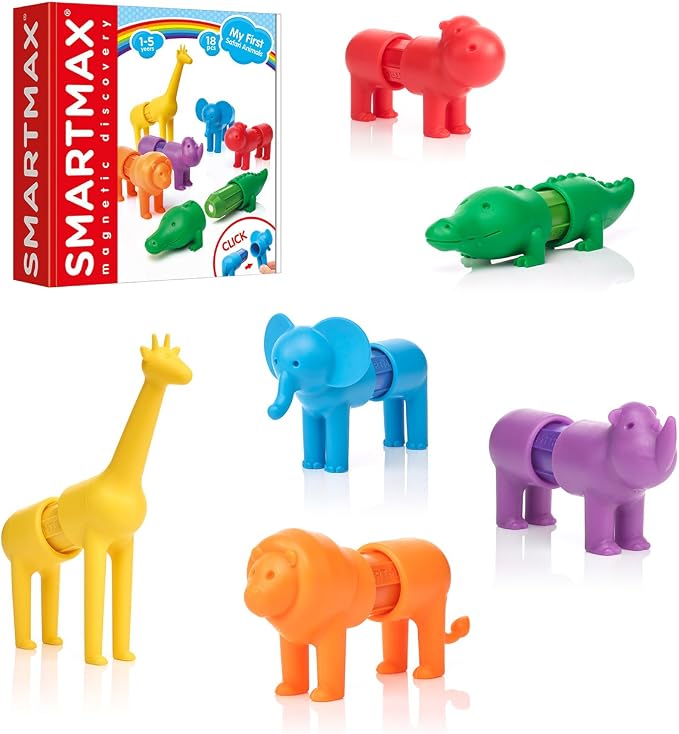
SMART Games My First Safari Animals
A compact logic activity that can also support free animal play before or after the included challenges.
Comparing positions, rotating pieces and checking an arrangement against a visual model.
Graded challenges can make the activity easier to revisit as the child becomes familiar with the pieces.
A durable set of figures and well-designed challenge material can support both structured and pretend play.
Confirm the current age grade, included challenges, piece size and storage.
 03
03
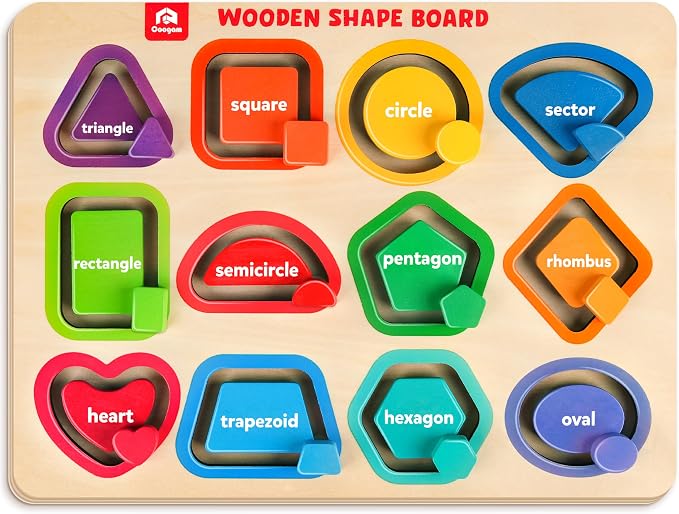
Coogam Wooden Colour Shape Puzzles
A colourful puzzle activity for children ready to compare shape, colour and position before placing each piece.
Matching, orientation, visual comparison and placement.
The task can be simplified by offering one puzzle or fewer pieces, then expanded later.
Multiple puzzle options can provide more range than one fixed matching board.
Confirm the current contents, piece dimensions, finish and age grade.
04
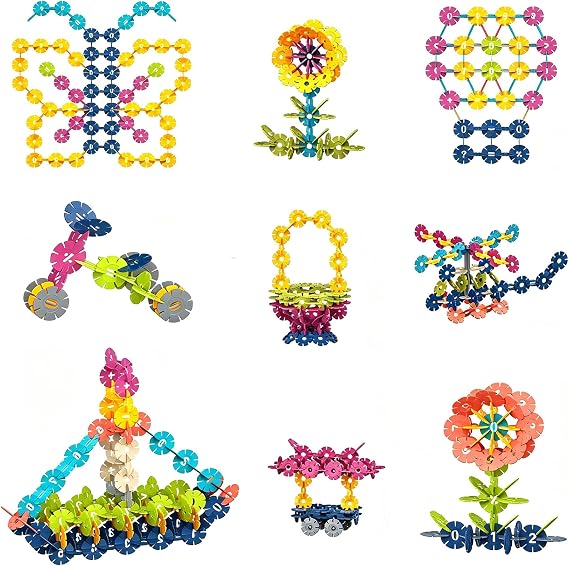
142-Piece Wooden Pattern Blocks and Smart Sticks
A generous set for copying patterns, building pictures or combining blocks and sticks into original designs.
Comparing shapes, rotating pieces, planning placement and changing a design.
The activity can range from free design to more structured pattern challenges.
A larger collection can add design variety if it also includes practical storage.
Confirm the age grade, piece dimensions, included cards and storage for all 142 parts.
 05
05
PlanToys Timber Tumble
A compact wooden game for stacking, balancing, predicting and rebuilding after the structure falls.
Predicting, placing, observing stability and revising the next move.
The physical result is immediate, and the pieces can also be stacked freely without formal game rules.
Durable wooden pieces and a design that works for both free play and a turn-taking game can add value.
Confirm the age grade and piece size. Inspect wood and finish for cracks, splinters or wear.
 06
06
Montessori Wooden Baby Toys, 7-Piece Sensory Rattle and Music Set
A coordinated baby set that offers several shapes and sounds without relying on one busy electronic toy.
Grasping, turning, shaking and comparing simple sound or handling experiences.
Presenting one or two pieces at a time keeps the activity calm and lets the baby explore at an individual pace.
A coordinated set can offer several age-appropriate experiences if each included item is well made and clearly labelled.
Confirm which pieces suit the baby's exact age. Inspect wood, joins and finishes, and check mouthing guidance.
 07
07
48-Piece Colour Sorting and Counting Dinosaurs
A larger counter set that can support sorting, simple counting, pattern-making and dinosaur stories.
Noticing features, applying a sorting rule, counting and inventing small-world scenes.
The same pieces can move between structured classification and open pretend play.
A larger set can add variety when the pieces are durable, clearly different and easy to store.
These are small loose pieces. Confirm the exact age grade, dimensions, quantity and storage.
 08
08
240-Piece Interlocking Building Blocks
A high-piece-count construction set for children who enjoy joining parts, testing structures and rebuilding in new ways.
Connecting, planning, testing stability and changing a design.
The pieces can become many structures, so the set supports open construction rather than one fixed finished model.
A larger set is worth considering when the connections hold well and practical storage is included.
Confirm the current age grade and component dimensions. Store all 240 small pieces away from younger children.
What the sources say about purposeful play
The evidence can help you think about how a child uses a toy. It cannot tell you that any one of these eight products will produce a particular developmental result.
Control of error is a useful Montessori principle
A material can give feedback that helps the child notice a mismatch without constant adult correction. A puzzle piece that does not fit or a balance structure that falls can invite another attempt.
Hands explore in different ways
Posting, turning, grasping and balancing offer different hand actions. A toy does not need to resemble a classroom exercise to invite repeated practice.
Montessori emphasised purposeful hand work
The original writing describes learning through purposeful activity and the senses. It does not prove that a particular retail toy changes the brain or raises intelligence.
Look beyond the material
Wood can feel pleasant and last well. Still, a secure join, suitable part size and age fit matter more than whether a listing calls a product wooden or Montessori.
The toy can leave room for conversation
In an in-home experiment with 26 parent and infant pairs, parents spoke more words per minute while playing with traditional toys or books than while playing with electronic toys. The infants were 10 to 16 months old. These are averages for three play conditions, not scores for the gifts on this page.
The study is a useful reminder that the adult’s attention and conversation matter too. A rattle can prompt “You heard it!” and a block set can prompt “What happens if this one goes on top?” None of this proves that a higher-priced toy improves language.
The more complex the gift, the more parts you need to inspect
Several products here contain balls, puzzle pieces, wooden components, counters or many small construction pieces. Those features deserve closer checking than the price tag.
Balls, counters, puzzle pieces and construction parts can become choking hazards if they are too small for the child.
Australian standard for toys up to 36 months →Trackers, puzzles and balancing games should be checked for loose parts, cracks, splinters and damaged finishes.
Kids' toys guide →Recheck current recalls, especially for marketplace or second-hand toys.
Search recalls →Count pieces after play and use practical storage so small components are not left where younger children can reach them.
Do not assume every piece in a multi-item set is suitable for mouthing or for every stage within a broad age range.
Verify the exact listing instead of assuming “non-toxic”, sustainable timber or solid hardwood.
Keep shopping by budget and play type
Gifts under $100 FAQs
Answers about value, age fit, play and checking the current product listing.
Are Montessori gifts under $100 better than cheaper toys?+
Not automatically. A higher budget can buy a larger set, more durable construction or more varied activities, but price is not a developmental score. A simple, well-matched lower-cost toy can be more useful than a complex toy the child is not ready to use.
What is worth paying more for in a Montessori-style gift?+
Pay more when the extra cost gives you something concrete: secure hardware, a stable base, more useful pieces, better storage, smoother mechanisms or an activity that can grow with the child.
Do fine-motor toys prepare children for handwriting?+
They can provide varied hand-use experiences, but no single toy directly produces handwriting readiness. Writing depends on a much broader mix of motor, visual, language and learning experiences.
What is the difference between a pincer grasp and a tripod grasp?+
A pincer grasp uses the thumb and index finger to pick up small objects. A tripod grasp involves the thumb, index and middle finger and is one of several functional ways children may hold tools. Grip development varies, and toys should not be used as pass-fail tests.
Are these gifts always available on Amazon Australia?+
No. The affiliate links lead to current product listings, but stock, seller, price, shipping, age grading and specifications can change. Confirm that the current price remains below $100 before buying.
Are hardwood toys safer or better than plastic toys?+
Not automatically. Material alone does not determine safety or play value. Stability, finish, hardware, piece size, age grading and the overall design matter more.
What age is best for pattern and construction sets?+
Follow the exact product age grade and the child's current abilities. Sets with many small pieces are generally better suited to children who no longer mouth toys and can manage the components safely.
How should I choose between the eight gifts?+
Choose by the child's current play interest first: tracking, matching, puzzles, patterns, balancing, sound exploration, sorting or construction. Then confirm the exact product is safe, appropriately challenging and currently below $100.