
Best Stacking, Nesting and Shape Toys for Toddlers in Australia
This guide focuses on building upward, fitting pieces together, nesting by size, posting objects and balancing. For toys centred mainly on matching coloured pieces, use our separate colour sorting toys guide.
They look similar, but the child is solving a different problem
Keeping the distinction clear makes it easier to choose a toy that fits what your child is currently interested in.
Stacking
Stacking is about position, balance and relative size. The child is asking: what goes under, over, inside or on top?
- Ring stackers
- Nesting cups
- Stacking arches
- Blocks and towers
Sorting
Sorting is about grouping by a chosen rule. This page covers shape, size and placement briefly, while our dedicated colour sorting guide compares colour-focused products.
- Shape fitting
- Size groups
- Matching containers
- Simple sequences
Three useful skills without overclaiming the outcome
Spatial comparison
Which piece fits inside, on top or through an opening? The child learns by trying and adjusting.
Order and size
Large, medium and small become concrete when objects can be directly compared and rearranged.
Classification
Colour, shape and size can each become a sorting rule once the child notices the relevant difference.
Eight stacking, nesting and shape-play picks at a glance
Every Amazon button below uses an exact affiliate link you previously supplied. Colour-only products are kept in the separate colour sorting guide.
| Pick | Best for | Age reference | Price |
|---|---|---|---|
| 10-Piece Stacking Cups | Nesting, stacking and pouring | Check listing | Check current price |
| Coogam Sorting & Stacking Toy | Stacking, fitting and patterns | 2 to 4 years in supplied title | Check current price |
| Fisher-Price Smart Stages Piggy Bank | Posting, emptying and repeating | 6+ months in supplied title | Check current price |
| SMART Games My First Safari Animals | Turning, stacking and spatial play | Check listing | Check current price |
| Learning Resources Peekaboo Learning Farm | Matching containers and pretend play | 18+ months in supplied title | Check current price |
| 142 Piece Pattern Blocks and Smart Sticks | Pattern copying and construction | Older preschool challenge | Check current price |
| PlanToys Timber Tumble | Balancing and careful placement | Check listing | Check current price |
| Melissa & Doug Magnetic Fishing Puzzle | Matching, lifting and placement | Check listing | Check current price |
Eight real products from your affiliate collection
The selection focuses on stacking, nesting, posting, balancing, matching and spatial play. It does not repeat the colour-focused product list from your separate colour sorting guide.
The child can see whether the goal is to stack, fit, group, order or continue a pattern.
You can reduce the number of pieces or categories instead of replacing the whole toy.
The tower falls, the piece does not fit or the grouping looks inconsistent.
Piece size, age grading, finish and loose components come before educational claims.
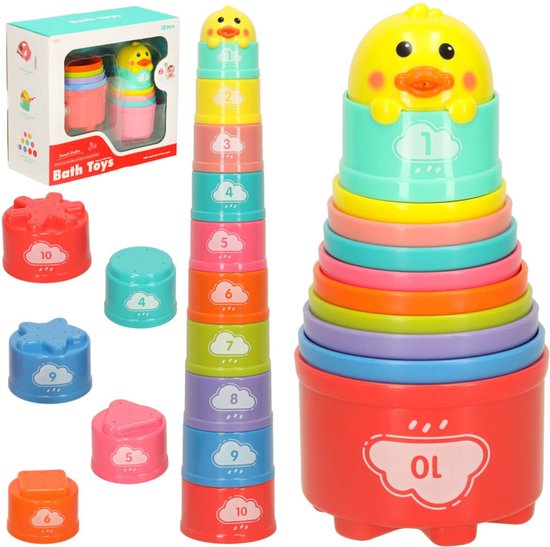
10-Piece Stacking Cups
This set can be nested, stacked, filled, tipped and used for supervised water play. The same cups can support a simple knock-down game first, then more deliberate size ordering later.
- Stack, nest, fill and pour
- Easy to simplify to three cups
- Broad open surfaces are easier to inspect
- Confirm the listing's current age grade
What to watch: Separate and dry every cup after water play instead of storing the set nested while wet.
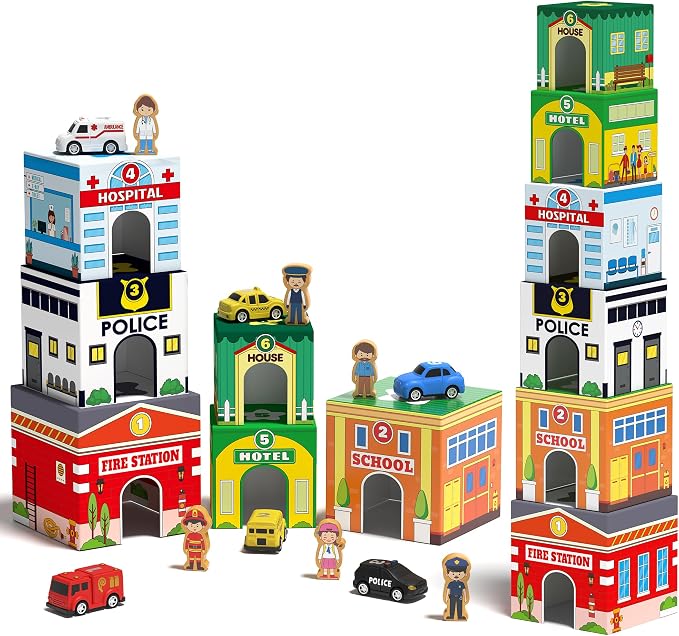
Coogam Sorting & Stacking Toy
This Coogam set can be used for removing and replacing pieces, building vertical arrangements and copying simple patterns. Offer only a small group of pieces when the complete setup feels too busy.
- Supports stacking and arrangement copying
- Difficulty can be reduced by removing pieces
- Gives visible feedback when a piece does not fit
- Check all loose-piece dimensions
What to watch: Follow the current manufacturer age grade and keep small pieces away from younger siblings.
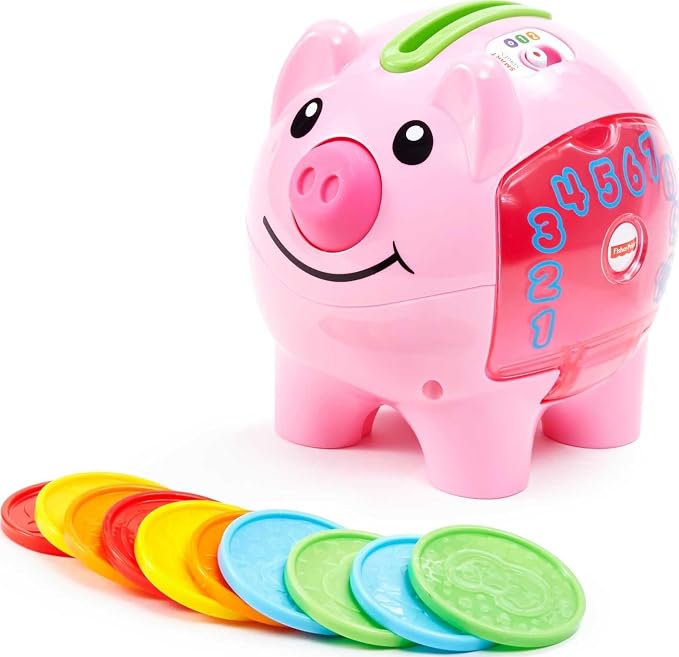
Fisher-Price Smart Stages Piggy Bank
This toy centres on a clear put-in sequence: pick up a large piece, place it through the opening, empty the bank and begin again. Younger children may focus on holding and dropping before they post deliberately.
- Large put-in pieces
- Clear opening and retrieval action
- Repeatable container play
- Secure the battery compartment
What to watch: Electronic sounds should remain secondary to the child's own posting and retrieval play.
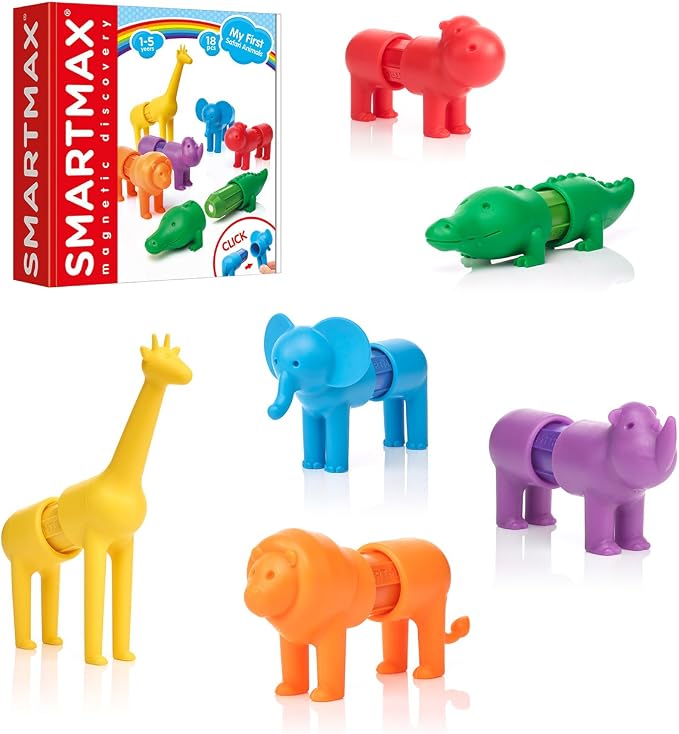
SMART Games My First Safari Animals
This set combines familiar animals with an early spatial challenge. Children can turn, stack and fit the pieces, then reuse the animals in simple pretend scenes.
- Spatial fitting and stacking
- Pieces can support pretend play
- Allows trial, adjustment and another attempt
- Confirm all piece sizes
What to watch: Check the current listing for the minimum age and exact challenge format.
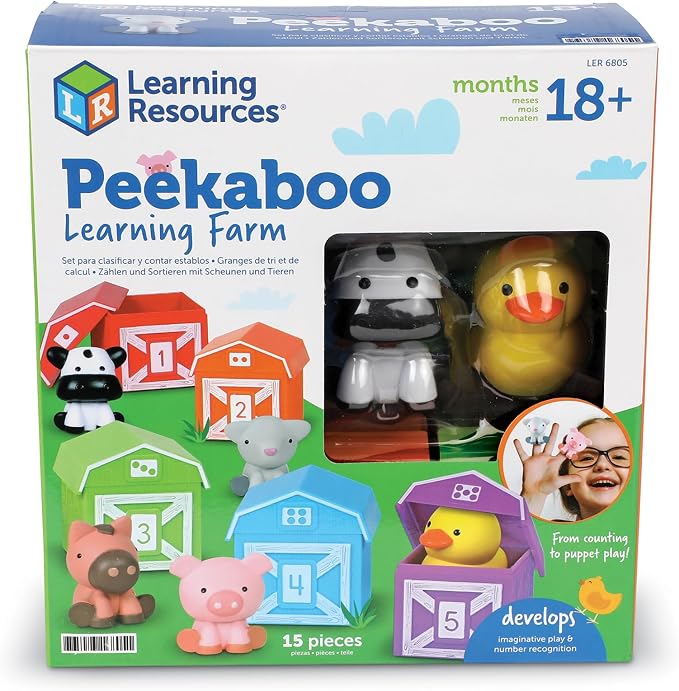
Learning Resources Peekaboo Learning Farm
Each animal and barn gives a toddler several connected actions: open, discover, match, hide and begin again. Start with two barns, then add more once the first matches are familiar.
- Open, hide, match and retrieve
- Easy to present in smaller groups
- Reusable for animal sounds and stories
- Count pieces after play
What to watch: Verify the current age grade and dimensions of every animal and barn.

142 Piece Wooden Pattern Blocks and Smart Sticks
This larger set moves beyond one correct recess. Children can copy a model card, combine blocks and sticks or create a new picture from their own arrangement.
- Model copying and free construction
- Several geometric pieces
- Challenge can increase gradually
- Useful for an older child
What to watch: The large number of small pieces makes this unsuitable as a first toddler toy. Follow the listing's age grade.

PlanToys Timber Tumble
Balancing pieces gives immediate physical feedback. A piece stays, shifts or tumbles, and the child can change the next attempt without a screen announcing a wrong answer.
- Visible cause and effect
- Encourages slow placement
- Can be replayed in different arrangements
- Use on a stable flat surface
What to watch: Confirm the minimum age and inspect every piece for damage before play.

Melissa & Doug Magnetic Fishing Puzzle
The fishing tool adds another step to a standard puzzle. The child guides it towards a piece, lifts the piece and works out where it belongs on the board.
- Lift, compare and place
- Can be simplified to any successful catch
- Adds a tool to the puzzle action
- Inspect every magnetic component
What to watch: Stop using the toy if a magnet or attached part becomes loose or damaged.
Loose sorting pieces can be small, so age grading matters
Use the product's exact age guidance and inspect pieces regularly, especially for children who still mouth objects.
Australian Government toy-safety guidance
Product Safety Australia publishes guidance for children's toys and a mandatory standard for toys intended for children up to and including 36 months. Small loose pieces, pegs and detachable parts deserve particular attention in sorting sets.
Inspect posts, pegs and painted pieces
Stacking toys can develop loose posts, chipped coatings or cracked pieces over time. Remove damaged parts and follow the manufacturer's care instructions.
What the evidence supports about stacking, sorting and play
These activities are best described as opportunities to compare, group, order and solve concrete problems, not as guaranteed maths or logic training.
Play gives children repeated practice
The American Academy of Pediatrics describes play as important for development and caregiver-child interaction. Stacking and sorting can fit within active play, but no individual toy guarantees gains in concentration, logic or later academic performance.
Montessori materials use concrete comparison
Original Montessori writing emphasises sensory discrimination, order and hands-on materials. Sorting and size-order activities can align well with those ideas when the difference being compared is clear.
Montessori program evidence is broader than toy evidence
Research on Montessori education evaluates the wider learning environment and method. It does not establish that a particular sorter or stacker independently improves mathematics or executive function.
What this page can responsibly evaluate
ToyBloom can compare task clarity, piece size, durability, adjustability and age fit. It should avoid claiming that size ordering automatically feeds later measurement or that classification is the foundation of scientific thinking.
Children do not move through stacking and sorting skills on a fixed schedule. If the child is still exploring by dumping or carrying the pieces, that does not mean the toy is failing. Simplify the setup and let the more organised play emerge when the child is ready.
How to choose the right stacking or sorting toy
Use these six checks before comparing brands.
1. Decide whether you want stacking or sorting
If the child loves building upward, start with stacking. If they are grouping objects, choose a sorter.
2. Start with one obvious variable
Colour, shape or size is easier to understand when only one rule matters at a time.
3. Reduce the number of pieces
You can offer three rings, two colours or a few shapes first, then add more later.
4. Check piece size carefully
Sorting sets often include loose pieces. Follow the exact product's age grade, especially for children who mouth objects.
5. Look for stable construction
Stacking bases and sorter boxes should stay put while the child works.
6. Skip unnecessary complexity
A clear single-purpose activity is often easier to learn from than a toy combining sorting, lights, sound and buttons.
Frequently asked questions about stacking and sorting toys
Direct answers without rigid developmental milestones.
What are the best stacking toys for toddlers?
Ring stackers, nesting cups and open-ended stacking pieces are strong options. Choose according to the child's current ability and the product's age grade.
What are the best sorting toys for toddlers?
Shape-fitting toys, matching containers and simple size activities are useful starting points. For products designed mainly around matching coloured pieces, compare the options in ToyBloom's colour sorting toys guide.
At what age do toddlers start sorting by colour?
There is no single age. Some toddlers begin matching colours earlier than others. Start with two clear colours and expand when the child understands the task.
Are stacking and sorting toys Montessori?
Many align well with Montessori principles, but not every commercial toy with the label is a classic Montessori material. Clear feedback, active use and manageable challenge matter more than branding.
Do stacking and sorting toys teach maths?
They can create opportunities to compare size, order and categories. That is useful experience, but no toy should be presented as a guarantee of later mathematical achievement.
What if my toddler only dumps the pieces?
That can still be normal exploration. Offer fewer pieces, model one simple action and avoid forcing a formal sorting task before the child is interested.