Best Open-Ended Play Toys for Toddlers in Australia
Open-ended toys are materials children can use in many ways without one required final result. Their value comes from flexibility: the same set can support building, arranging, carrying, pretending or combining with other toys depending on what the child is interested in.
Flexible use, not a promise of creativity
Open-ended is a useful description of the material, but it should not be treated as proof that a child will play longer, focus more deeply or become more creative.
Strong open-ended qualities
- More than one reasonable way to use the material.
- No required final arrangement or fixed sequence.
- Easy to combine with blocks, figures, fabric, boxes or other materials.
- Can be simplified or expanded without replacing the whole toy.
- The child creates the action rather than the toy performing it.
Not necessarily open-ended
- A puzzle with one correct solution.
- A toy that mainly produces preset lights or sounds.
- A game where success depends on following one fixed sequence.
- A role-play toy that can only be used in one scripted way.
- A material that becomes unusable once a single task is completed.
The same material may support different play without a rigid age ladder
These are examples, not milestones. Children may skip, repeat or combine these kinds of play in different orders.
Explore the object
Carry, bang, roll, stack, dump or simply examine the material.
Repeat a simple action
Build short towers, line objects up, fill containers or arrange pieces.
Build with a plan
Use materials as roads, bridges, enclosures, patterns or scenes.
Add story and meaning
Blocks become buildings, discs become pretend money and figures become characters.
The 8 open-ended picks at a glance
These real products cover construction, patterns, animal stories, sorting, sensory play, climbing, vehicle play and balancing. The best choice adds a new kind of play instead of repeating something already on the shelf.
| Pick | Open-ended strength | Age guidance | Before buying |
|---|---|---|---|
| 240-piece interlocking blocks | Structures, creatures, vehicles and experiments | Confirm current listing | Check small-piece suitability |
| Wooden pattern blocks and sticks | Pictures, patterns and construction | Ages 3 to 5, per supplied title | Store small pieces securely |
| SMART Safari Animals | Stories, habitats, sorting and visual challenges | Confirm current listing | Check piece size |
| 48-piece dinosaur counters | Sorting, counting and small-world play | Ages 3 to 5, per supplied title | Keep away from younger children |
| 14-piece sensory-bin tools | Transferring, pouring and pretend setups | Confirm current listing | Choose safe fillers |
| 7-in-1 wooden climbing set | Climbing routes, bridges and movement stories | Confirm current listing | Follow setup and weight guidance |
| HONEY JOY ride-on excavator | Construction stories, steering and scooping | Ages 3+, per supplied title | Use a safe riding area |
| PlanToys Timber Tumble | Free balancing, stacking and arranging | Confirm current listing | Inspect wood and finish |
The 8 picks, rewritten with stronger open-ended-play guidance
The selection method focuses on flexibility, combination potential, construction quality, piece size and whether the child controls the play.
The material can reasonably support more than one kind of play.
The child decides what to build, arrange, carry or imagine.
The toy becomes more useful when paired with blocks, figures, fabric or containers.
Piece size, magnets, materials and age grading come before open-endedness.
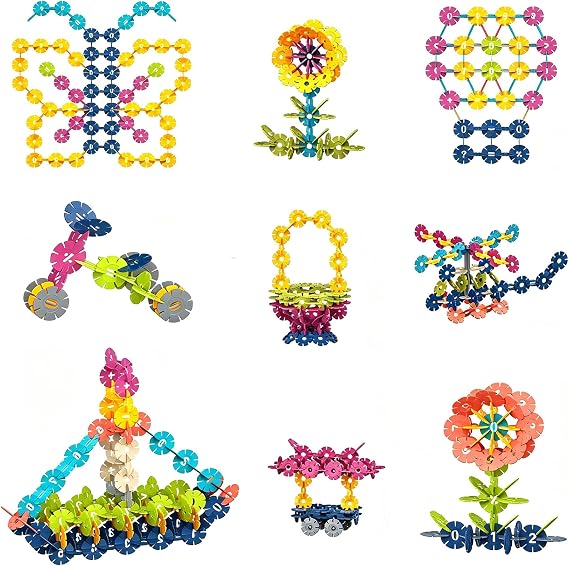
240-Piece Interlocking Building Blocks
A large set of interlocking pieces lets children connect, test, pull apart and rebuild. The pieces can become vehicles, shapes, creatures or structures rather than leading to one required final model.
- construction
- engineering play
- creative design
- child-directed use
Why it is open-ended: The same pieces support quick experiments and longer projects, and failed connections provide useful physical feedback.
Safety check: This set contains many small components. Confirm piece dimensions and age grading, and keep every piece away from younger siblings.

142-Piece Wooden Pattern Blocks and Smart Sticks
Pattern blocks and sticks can be arranged into pictures, borders, repeating designs and original structures. Challenge cards are optional rather than the only way to play.
- patterns
- pictures
- construction
- child-directed use
Why it is open-ended: The pieces can shift between open design and more focused pattern challenges, so the adult can adjust structure without replacing the set.
Safety check: Confirm the current age grade and piece size. Store the many small parts securely and count them after play.
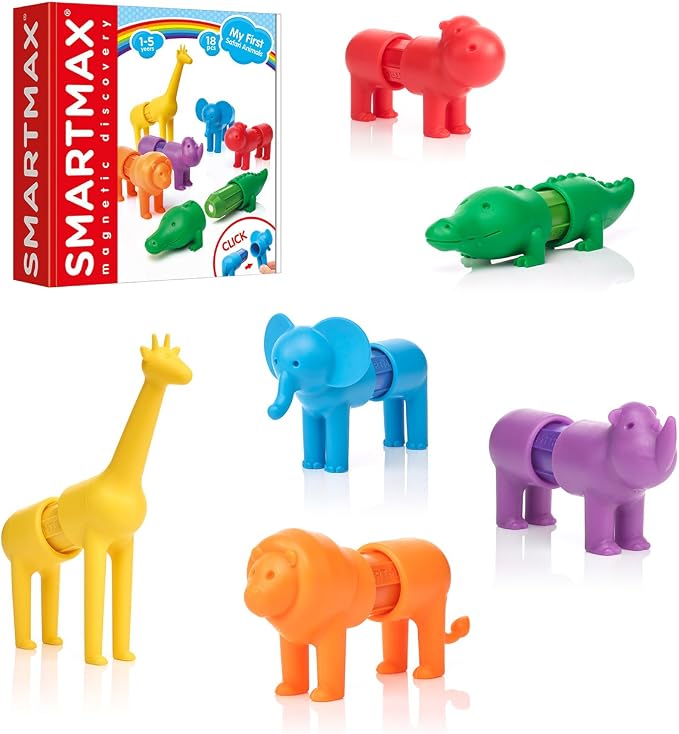
SMART Games My First Safari Animals
Animal pieces can support free storytelling, sorting and small-world scenes before or after the included game challenges. They can join blocks, roads and homemade habitats.
- pretend play
- classification
- small worlds
- child-directed use
Why it is open-ended: The figures can work as characters, sorting objects or puzzle pieces, allowing the same set to support different types of play.
Safety check: Confirm the current age grade and piece size. Keep all components together and check that none are damaged.

48-Piece Colour Sorting and Counting Dinosaurs
Dinosaur counters can be grouped by colour or type, lined up, counted, hidden in sensory materials or used as characters in a small-world scene. The child can decide whether the activity is mathematical or imaginative.
- sorting
- counting
- dinosaur stories
- child-directed use
Why it is open-ended: One set can support free play, classification, simple counting and story-making without requiring one correct arrangement.
Safety check: These are small loose pieces. Follow the current age grade, supervise as needed and store them securely away from younger children. Compare more options in the colour-sorting toy guide.

14-Piece Wooden Sensory Bin Tool Set
Tongs, spoons, bowls and a rolling pin can be used with water, dough, fabric pieces or another age-appropriate material. The tools do not dictate one finished result.
- scooping
- transferring
- pretend play
- child-directed use
Why it is open-ended: The tools remain useful across different setups, which gives them more range than a single pre-filled sensory activity.
Safety check: Choose fillers according to age and mouthing behaviour. Supervise directly, avoid choking hazards and store every tool after play.

7-in-1 Foldable Wooden Climbing Set
A climbing triangle, ramp and related pieces can be rearranged for climbing, crawling, sliding, hiding and imaginative movement. A ramp can become a bridge, counter or pathway when used within the manufacturer’s instructions.
- climbing
- ramps
- movement stories
- child-directed use
Why it is open-ended: The equipment can support several movement routes and pretend scenarios rather than one fixed course.
Safety check: Follow the exact assembly, placement, age, weight and supervision guidance. Keep it away from stairs, hard edges and unsafe fall zones. See more options in the toddler climbing toy guide.

HONEY JOY Kids Ride On Excavator
A child-controlled excavator can become part of road building, stone moving, rescue stories or an outdoor construction site. Steering and scooping are tools for the story rather than a fixed electronic sequence.
- pretend play
- movement
- construction stories
- child-directed use
Why it is open-ended: The child decides what to move, where to drive and what role the machine plays, combining movement with imaginative planning.
Safety check: Follow the current weight, surface, footwear, helmet and supervision guidance. Keep play away from roads, water, steps and slopes.

PlanToys Timber Tumble
Although sold as a game, the wooden pieces can also be freely stacked, balanced, arranged and combined into small structures. Rules can be added only when the child wants them.
- balance
- stacking
- experimentation
- child-directed use
Why it is open-ended: The pieces allow prediction and revision, but they also work as simple loose construction materials outside a turn-taking game.
Safety check: Confirm current age guidance and piece size. Stop using any wooden piece that develops cracks, splinters or a damaged finish.
Open-ended does not mean anything can become a toddler toy
Loose parts and magnetic construction sets need particularly careful product selection.
Australian Government toy-safety guidance
Product Safety Australia publishes guidance for children's toys and a mandatory standard for toys intended for children up to and including 36 months. For loose parts, piece size and whether an object can break, splinter or detach matter more than whether it looks natural.
Added components can change the risk
Open-ended toys can still contain magnets, batteries, cords, fasteners or small connectors. If a product cracks or separates, internal parts may become accessible. Remove damaged toys immediately and follow the exact manufacturer instructions.
What the evidence supports about open-ended play
Open-ended materials can create opportunities for children to choose goals and vary their play, but they should not be marketed as guaranteed creativity or executive-function tools.
Play supports development through active engagement
The American Academy of Pediatrics describes play as important for child development and caregiver-child interaction. That supports offering active, flexible play opportunities, but it does not prove that one open-ended toy produces superior creativity.
Montessori is not the same as open-ended play
Classic Montessori education includes many carefully designed materials with a specific purpose or control of error. Some open-ended materials can fit a Montessori-inspired home, but open-ended should not be treated as a defining feature of every Montessori material.
Montessori program evidence is broader than toy evidence
Research on Montessori education evaluates a wider learning environment and method. It does not prove that a block set, rainbow or loose-parts basket independently creates developmental gains.
What this page can responsibly evaluate
ToyBloom can compare flexibility, safety, combination potential, durability and age fit. It should avoid claims that open-ended toys always produce longer focus, better creativity or deeper learning than closed-ended toys.
Open-ended and closed-ended toys can both be useful. A puzzle offers a clear problem with one solution. Blocks offer many possible results. A balanced play space can include both kinds of material rather than treating one category as superior.
How to choose an open-ended toy
Use these six checks before comparing brands.
1. Ask how many uses you can imagine
If the same pieces can build, sort, carry, pretend or combine with other materials, the toy has strong open-ended potential.
2. Check whether the child drives the action
Prefer materials where the child decides what happens instead of following a fixed electronic sequence.
3. Think about combination
Blocks become more interesting with figures. Fabric works with boxes. Balls work with ramps. Compatibility can matter more than complexity.
4. Choose age-appropriate piece sizes
Loose parts should never be selected just because they are attractive or natural. Follow the child's age and mouthing behaviour.
5. Avoid buying too much at once
A smaller set can make it easier to see how the child actually uses the material before expanding the collection.
6. Inspect materials regularly
Check wooden pieces, connectors, coatings, moving parts and climbing equipment for damage before continued use.
Frequently asked questions about open-ended toys
Direct answers without overclaiming creativity or longevity.
What are open-ended toys?
They are toys or materials that can be used in many different ways without one required final result. Blocks, loose parts, figures, arches and construction tiles are common examples.
Are open-ended toys Montessori?
Some fit well in Montessori-inspired homes, but open-ended does not automatically mean Montessori. Classic Montessori includes many specific-purpose materials as well.
What are the best open-ended toys for toddlers?
Interlocking blocks, pattern pieces, animal figures, counters, sensory-bin tools, rearrangeable climbing equipment, child-controlled vehicles and balancing pieces are strong options.
Are loose parts safe for toddlers?
Only when every piece is appropriate for the child's age and active supervision is provided. Avoid small, sharp, breakable or shedding objects, magnets, button batteries and choking hazards.
Do open-ended toys improve creativity?
They can create opportunities for children to choose their own goals and constructions, but no toy should be presented as a guarantee of greater creativity.
Are magnetic tiles good open-ended toys?
They can be excellent construction materials when the magnets are securely enclosed and the tiles remain undamaged. Inspect them regularly and remove cracked or separating tiles immediately.