Montessori baby toys

Best Montessori Toys for 6-12 Months in Australia

Between 6 and 12 months, a useful toy does not need to do much. The strongest choices make it easy for the baby to grasp, transfer, roll, drop, retrieve, stack or repeat a simple action with their own hands.

Start with the baby's current abilities, then choose one small next challenge. This guide compares eight real products, what each one is best for and what to check before buying.

New to the approach? Read what Montessori toys actually are before comparing the options.

6 to 12 months Australian shopping context Hands-on play Research-aware guidance
Baby and toddler age-based Montessori toy guidance
Quick filter Look for one clear action, easy handling and an age grade that fits the individual product.

What are the best Montessori toys for 6 to 12 months?

Good options include easy-grip balls, lightweight rattles, sensory sets, textured balls, stacking cups, large-piece posting toys and carefully chosen activity toys. The best match depends on what the baby can already do comfortably.

This is a comparison guide, not a list of eight toys every baby needs. One or two well-matched choices are enough to begin.

Developmental fit

Think in stages, not a single 6 to 12 month box

A six-month-old and an almost-one-year-old can interact with the same object very differently. Use the month range as orientation, then watch what the baby actually attempts.

If your baby is still working mainly on looking and early grasping, start with the 0 to 6 month baby-toy guide. If first-birthday play is becoming more relevant, continue to the Montessori toy guide for 1 year olds.

6-8

Grasp, transfer and mouth

Choose objects that are easy to hold, inspect and move between hands.

8-10

Roll, reach and repeat

Look for simple movement, cause-and-effect and objects that invite reaching or retrieval.

10-12

Drop, place and stack

Simple containers, stacking actions and posting-style play often become more interesting as hand control grows.

ToyBloom 6 to 12 month play progression A visual pathway from grasping to rolling and then placing and stacking. GRASP hold + transfer ROLL reach + retrieve PLACE drop + stack Use this as a play map, not a milestone test.
Watch the play, not the packaging

A simple toy should make the baby's action obvious

The strongest 6 to 12 month toys usually invite a small number of repeatable actions. The baby reaches, grips, turns, rolls, drops, retrieves or stacks. That direct feedback is often more useful than a long list of electronic features.

For a broader explanation of looking, reaching, grasping and floor play, visit the activity toys for babies guide.

  • Choose one clear action before adding complexity.
  • Watch whether the baby returns to the object without constant adult prompting.
  • Rotate toys based on interest rather than changing everything on a fixed schedule.

See the Montessori toy rotation guide →

Quick picks

8 Montessori-style toys for 6 to 12 months

Use the table to shortlist real products by the action your baby is ready to practise. Follow the exact listing and package age guidance before purchase.

Toy typeBest forWhen it often fitsWhy parents shortlist it
Bright Starts Oball RattleGraspingListed from newbornMany easy grip points
Wooden Star RattleHold + shakeListed for 0 to 12 monthsSimple sound and hand transfer
7-Piece Sensory Rattle SetVaried handlingListed for 0 to 12 monthsSeveral sounds and shapes
Montessori Sensory BallTexture + rollListed for 0 to 12 monthsGripping, rolling and retrieval
Smart Stages Piggy BankPost + retrieveListed from 6 monthsLarge-piece posting play
10-Piece Stacking CupsStack + nestCheck current listingUseful across several play stages
YOLOMOON Busy CubePull + turnListed for babies and toddlersCompact travel activity
Wooden Push WalkerStand + pushListed for 6 to 12 monthsLater-stage movement play
Affiliate disclosure: The buttons below use ToyBloom affiliate links. ToyBloom may earn from qualifying purchases at no extra cost to you. Listings, designs, age guidance and availability can change, so check the exact product information before buying.
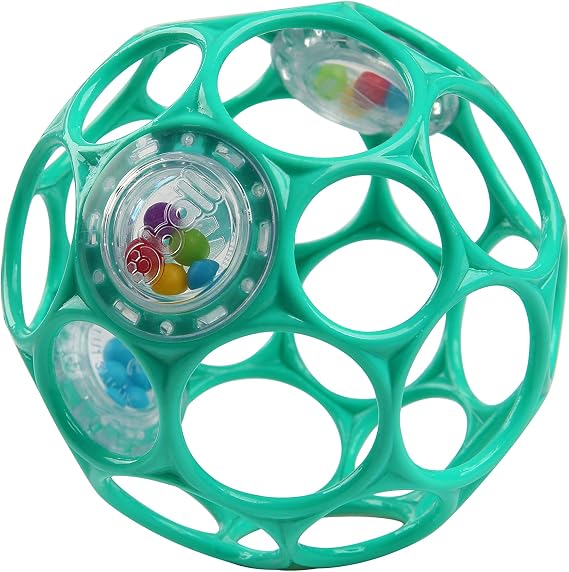
Bright Starts Oball Easy-Grasp Rattle in teal
Best for early grasping

1. Bright Starts Oball Easy-Grasp Rattle

The flexible open design gives small hands many places to hold. The four-inch Oball can be turned, shaken, transferred between hands and rolled a short distance without requiring a complicated action.

  • Multiple grip points
  • Easy to turn and transfer
  • Supports simple rolling play
  • Works well on a floor mat

Listed age: newborn and up. Inspect the rattle and flexible frame regularly for damage.

Check on Amazon →
Wooden star-shaped Montessori baby rattle in earthy colours
Best for two-hand exploration

2. Wooden Star-Shaped Baby Rattle

This compact wooden rattle combines a star shape with a gentle shaker sound. The open points create several grip positions for turning, passing between hands and bringing the toy toward the body.

  • Several hand positions
  • Encourages bilateral handling
  • Simple form
  • Easy to rotate in the hands

Listed age: 0 to 12 months. Check the finish, seams and internal sound component before use.

Check on Amazon →
Seven-piece Montessori wooden sensory rattle and music set for babies
Best varied rattle set

3. Seven-Piece Montessori Sensory Rattle and Music Set

This set offers several shapes, sounds and grip positions rather than one repeated design. Present one item at a time so the baby can explore its weight, sound and movement without the full set becoming clutter.

  • Seven different pieces
  • Several grip shapes
  • Simple sound exploration
  • Can be rotated one at a time

Listed age: 0 to 12 months. Count every piece and inspect the finish and sound components before play.

Check on Amazon →
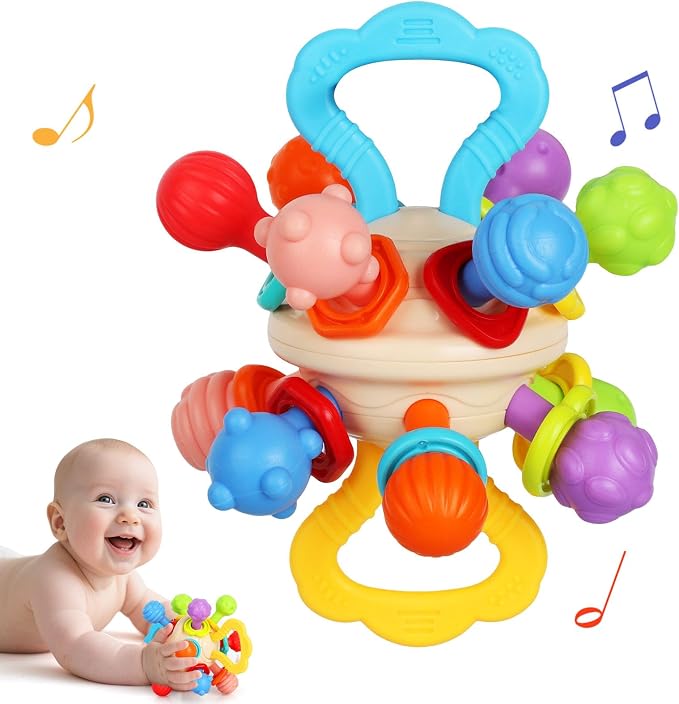
Montessori sensory ball and rattle for babies from 0 to 12 months
Best sensory ball

4. Baby Montessori Sensory Ball

This sensory ball can be held, turned, shaken and rolled. Its textured form provides a simple object for floor play without adding a large activity centre or a long list of unrelated features.

  • Easy-grip textured form
  • Can be rolled and retrieved
  • Includes rattle feedback
  • Compact for travel

Listed age: 0 to 12 months. Confirm the current materials, cleaning instructions and product condition.

Check on Amazon →
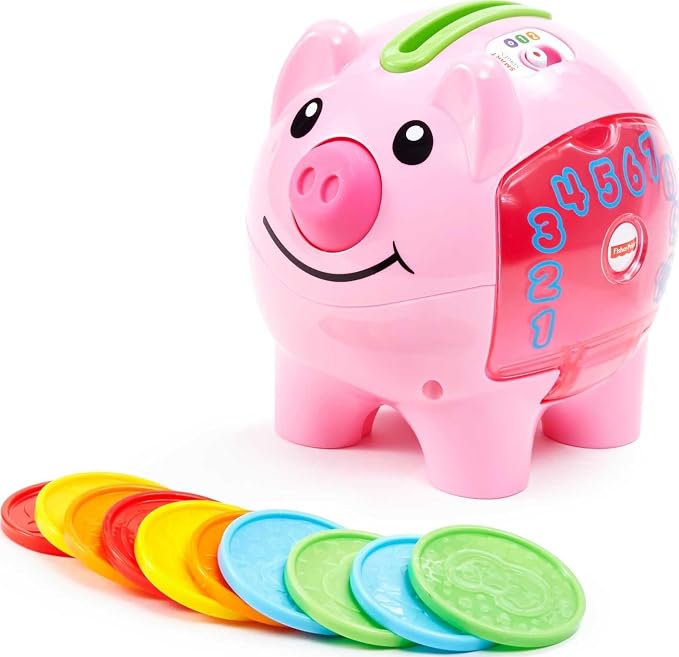
Fisher-Price Smart Stages Piggy Bank with large colourful posting coins
Best first posting toy

5. Fisher-Price Smart Stages Piggy Bank

The piggy bank turns one action into a repeatable sequence: pick up a large coin, aim for the slot, release it and retrieve it to begin again. Songs and phrases make it more stimulating than a traditional posting box.

  • Large posting pieces
  • Clear slot target
  • Door for retrieval
  • Repeatable in-and-out play

Listed age: 6 months and up. Check the coin size, battery enclosure and current package guidance.

Check on Amazon →
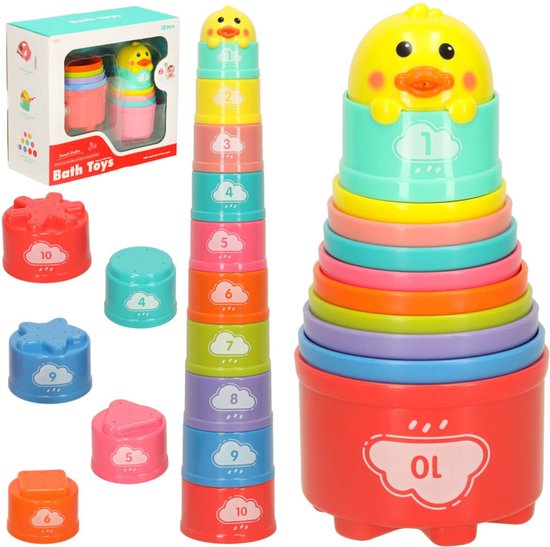
Ten colourful stacking and nesting cups for babies
Best all-rounder

6. Stacking Cups

Stacking cups can stay useful for a long time because the play changes. Early on, the baby may simply hold, mouth, knock down or bang two cups together. Later, the same set can support nesting, stacking, filling and emptying.

  • Many simple uses
  • Stack and nest
  • Easy to knock down and rebuild
  • Useful beyond this age range

Fit: confirm the current age guidance. Inspect rims for cracks and dry every cup fully after water play.

Check on Amazon →
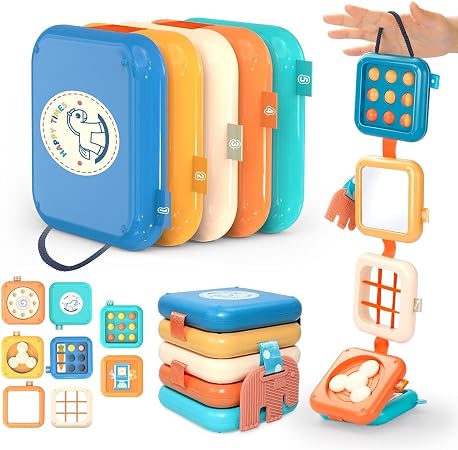
YOLOMOON Montessori sensory busy cube for babies and toddlers
Best compact activity toy

7. YOLOMOON Montessori Sensory Busy Cube

This soft-sided busy cube combines several hands-on mechanisms in a compact format. For younger babies, present one side and one action at a time instead of expecting every feature to be used.

  • Several hand activities
  • Compact travel format
  • Different textures
  • Can be simplified to one side

Listed use: babies and toddlers. Confirm the exact model's age guidance and inspect every seam, cord and attachment.

Check on Amazon →
Wooden baby push walker activity toy for babies learning to stand and walk
Best later-stage movement toy

8. Wooden Baby Push Walker Activity Toy

A push-from-behind walker can provide a movable surface for a baby who is already pulling to stand and beginning to step. It does not teach walking by itself, and it is not suitable simply because the baby has reached a certain month.

  • Push-from-behind design
  • Front activity panel
  • Later-stage gross-motor play
  • Useful near the first birthday

Listed age: 6 to 12 months. Test speed and stability on the actual floor, block stairs and remain within arm's reach.

Check on Amazon →
Australian product checks

What to check before a toy goes into the play area

For babies under one, the product's age grading, construction and condition matter more than whether the marketing calls it Montessori.

Pay close attention to button batteries and magnets

For any product that contains a button battery or magnet, inspect the enclosure carefully and follow the product's instructions and age guidance. The Australian Government has dedicated consumer guidance for both categories.

Research context

What Montessori research tells us, and what it does not

Research on Montessori education is useful background, but it should not be turned into a marketing claim for a retail toy.

A retail toy is not a Montessori classroom

Those studies evaluate educational programs, not individual toys. They do not prove that buying a rattle, sensory ball, stacking toy or posting toy independently improves intelligence, language, reading or executive function.

That is why this guide uses research as context and judges consumer toys through observable questions: Is the purpose clear? Is the child doing the action? Does the toy fit the child's current abilities? Can the activity be repeated without the toy doing all the work?

Buying guide

What to look for in Montessori toys for 6 to 12 months

A good buying decision begins with product suitability and developmental fit, then moves to play value.

1. Start with the product's age grading

Do not assume that a toy is appropriate for a baby because it looks simple. Follow the manufacturer's age guidance and warnings for the specific product.

2. Prefer one obvious action

For this age, a toy that rolls, drops, stacks or transfers clearly can be more usable than an activity centre with many unrelated functions.

3. Look at the size and grip

The baby should be able to hold or manipulate the object without needing fine control that is not there yet. Large, easy-grip forms are often easier to explore. The fine-motor toy guide explains how these challenges change as children grow.

4. Think about the next action

Choose a toy that adds one manageable challenge beyond what the baby already does. For example, moving from holding a ball to rolling it, or from dropping an object to placing it into a container.

5. Avoid buying every stage at once

A smaller set lets you see what the baby actually uses. Store the rest and reintroduce later. The ToyBloom toy rotation guide explains a simple approach.

6. Check the toy as it ages

Inspect toys over time for loosened parts, cracks, broken enclosures or other changes. This matters especially for second-hand toys and products that are frequently dropped or mouthed.

Quick answers

Frequently asked questions

Short answers first, then deeper explanation where it helps.

What Montessori toys are best for a 6 month old?

Start with grasping and reaching. An easy-grip ball, lightweight rattle or age-appropriate sensory ball can be useful when the individual product is graded for the baby.

What Montessori toys are useful from 9 to 12 months?

Look for repeatable post, retrieve, stack and place actions. Stacking cups, large-piece posting toys and carefully chosen activity toys can become interesting as hand control grows.

Do Montessori baby toys need to be wooden?

No. Wood can be durable and pleasant to handle, but material alone does not make a toy Montessori-style. Silicone, fabric and other suitable materials can also work when the design is simple and purposeful. See the wooden Montessori toys guide for a deeper comparison.

How many toys should a 6 to 12 month old have out at once?

There is no required number. A small visible selection can make it easier to notice what the baby actually uses. Rotate according to interest rather than changing toys on a rigid schedule.

Is a posting toy useful for every baby in this age range?

No. Posting becomes more usable when the baby is already intentionally releasing objects. If the activity is frustrating, store it and offer a simpler grasping or rolling toy instead.

Affiliate disclosure: ToyBloom.com.au is a participant in the Amazon Associates Programme, an affiliate advertising programme designed to provide a means for sites to earn advertising fees by advertising and linking to Amazon.com.au. As an Amazon Associate ToyBloom may earn from qualifying purchases. This does not affect the price you pay.