
What is Montessori, and where do toys come into it?
Maria Montessori was an Italian physician and educator who developed her approach to education in the early 1900s while working with children in Rome. Her method was built on a central observation: children are not empty vessels to be filled with knowledge. They are natural learners who, when given the right environment and the right materials, teach themselves.
The "right materials" part is where Montessori toys enter the picture. In a genuine Montessori classroom, the learning materials (called "Montessori materials" rather than toys) are carefully designed to isolate a single concept, present it clearly and allow a child to work with it independently until they understand it. Every material has a purpose, and that purpose is transparent to the child.
"The most important period of life is not the age of university studies, but the first one, the period from birth to the age of six."
Maria MontessoriWhen toy manufacturers use the word "Montessori," they are borrowing that philosophy and applying it to consumer products. Sometimes they apply it accurately. Often they do not. A toy with the Montessori label might be a genuine, thoughtfully designed wooden activity material. It might also be a plastic sorting cube with eight sounds and a flashing light.
The label does not make the toy. Understanding the principles does.
The five principles that define a genuinely Montessori toy
You do not need to memorise Montessori's full educational theory to choose good toys. These five principles cover the vast majority of what you need to know.
One clear purpose
A Montessori material does one thing. An object permanence box teaches object permanence. A knob puzzle develops the pincer grip and shape recognition. A stacking ring set teaches size sequencing. The clearer the purpose, the more completely a child can engage with it.
Self-correcting design
The best Montessori materials tell a child when they have made an error, without the child needing adult correction. A puzzle piece that does not fit its slot, a ring too large to go over the peg, a shape that will not post: these are built-in error controls that give the child information to act on.
Hands-on, child-led action
A Montessori toy does not perform for the child. The child performs. Pressing a button that makes a toy dance is not Montessori play. Stacking a tower, threading a lace, pouring water from one vessel to another: these are Montessori actions because the child creates every outcome through their own effort.
Simple, natural materials
Wood, cotton, natural rubber and metal are preferred over plastic. Natural materials are heavier and more satisfying to handle, respond differently to touch and temperature, and do not flex or break in the ways plastic does. They also tend to have a smaller number of moving parts, which keeps the child's focus on the intended skill.
Appropriate developmental challenge
A Montessori toy sits just ahead of where a child currently is. Not so easy that it is mastered in thirty seconds, not so hard that it is endlessly frustrating. That zone of proximal challenge is what produces the deep, sustained concentration Montessori educators call "the work." A child in "the work" can focus on a single activity for twenty minutes or more, returning to it repeatedly across days and weeks.
Ready to find toys for your child's age?
Our age guides go into detail on every developmental stage from 6 months to 4 years.
Montessori toys vs conventional toys: what actually differs
The most useful comparison is not between brands but between play types. Here is how Montessori-aligned materials differ from conventional toy categories across the things that matter most for child development.
| Feature | Montessori-aligned | Conventional toy |
|---|---|---|
| Who creates the action | The child always | Often the toy itself |
| Battery required | Almost never | Frequently |
| Error feedback | Built into the material | Usually requires adult |
| Primary material | Wood, cotton, rubber, metal | Plastic most common |
| Number of features | One, clearly defined | Often many |
| Sounds and lights | Rarely | Very common |
| Developmental lifespan | Months to years per toy | Often weeks to months |
| Open-ended use | Often high | Varies widely |
| Fantasy or realistic design | Realistic preferred | Both, fantasy very common |
| Parent involvement required | Optional, not required | Often required to facilitate |
Open-ended play (where there is no single correct outcome) is not exclusively Montessori, but it is aligned with Montessori values at most ages. Unit blocks, balancing stones and loose parts all support open-ended play while also meeting the other Montessori criteria. A toy does not have to have one fixed use to be Montessori-aligned: it has to put the child in control of the outcome.
How to spot a genuine Montessori-aligned toy when shopping
You will encounter the Montessori label on everything from well-designed hardwood materials to battery-powered plastic toys with LED displays. Here is a practical checklist to cut through the noise.
Signs a toy is genuinely Montessori-aligned
- The child creates every action: nothing happens until the child makes it happen
- There is one clear skill or concept being practised
- The toy gives feedback without adult explanation: pieces do not fit, rings do not stack out of order, shapes do not pass through wrong holes
- Natural materials: solid wood, natural rubber, cotton, ceramic or metal
- No batteries, sounds or flashing lights
- A child can use it independently after one demonstration
- The activity is achievable with effort but not instantly mastered
Signs to treat with caution despite the Montessori label
- Requires batteries for core function
- Produces sounds or music as part of normal use
- Has five or more different activities in one product
- Made primarily from thin or hollow plastic
- Features licensed characters or branded imagery
- Requires adult facilitation to be meaningfully used
- Gives verbal praise or rewards with sound effects when a child succeeds
Busy boards are one of the most common products sold with a Montessori label that do not meet Montessori criteria. A genuine Montessori practical life activity isolates one skill: pouring, locking, folding. A busy board combines fifteen different activities on a single board, which contradicts the isolation of difficulty principle central to Montessori design. This does not make busy boards without value, but it does mean they are not Montessori in the genuine sense of the word.
What Montessori toys look like at each age
The right Montessori material changes significantly across the 0 to 4 age range. What challenges a 1 year old is mastered within weeks by a 3 year old. Here is a brief overview of what each stage calls for.
Babies (0 to 12 months)
In the first year, Montessori materials focus on sensory exploration and early cause-and-effect understanding. High-contrast visual mobiles (the Munari mobile from birth, the Gobbi mobile from around 6 weeks) are classic first Montessori materials. From 4 months, simple wooden or natural rubber grasping toys and sensory balls are appropriate. From 6 to 9 months, object permanence materials, where objects disappear and reappear, become the defining activity of the age.
1 year olds (12 to 18 months)
This is the period of posting, stacking and early problem solving. Object permanence boxes, coin boxes, knob puzzles and stacking rings are the classic materials. Fine motor development centres on the pincer grip and wrist rotation. The push walker supports the gross motor milestone of walking. Every material at this age should have a single, clear, physically satisfying outcome that the child can create and repeat independently.
2 year olds (18 to 36 months)
Sorting, matching and practical life activities define the two year old period. Colour sorting trays, simple jigsaw puzzles, lacing beads, realistic animal figurines and pouring sets are all developmentally well-matched. Language development is at its most rapid phase, and any material that gives a child something concrete to name, describe and categorise has enormous value. Open-ended materials like balancing stones and peg dolls begin to support extended pretend play.
3 year olds
Three year olds are ready for genuine complexity. Unit blocks, twelve-piece jigsaw puzzles, beeswax or watercolour art materials, counting beads, tangram sets and practical life activities that require multiple steps (pouring, spooning, folding) are all appropriate. Mathematical thinking becomes concrete at this age: counting objects, comparing quantities and understanding simple addition through physical manipulation are achievable and deeply engaging.
See the full guide for each age group
Each age guide covers the developmental context in detail and recommends eight specific toys matched to that stage.
Where to start: three picks to understand what this looks like in practice
The best way to understand what makes a toy genuinely Montessori is to look at specific examples side by side. These three picks across three age groups illustrate the principles in action.

Object Permanence Box
The most classically Montessori toy at this age. One action, one outcome, one concept. A child drops a ball, watches it vanish, finds it in the tray below.
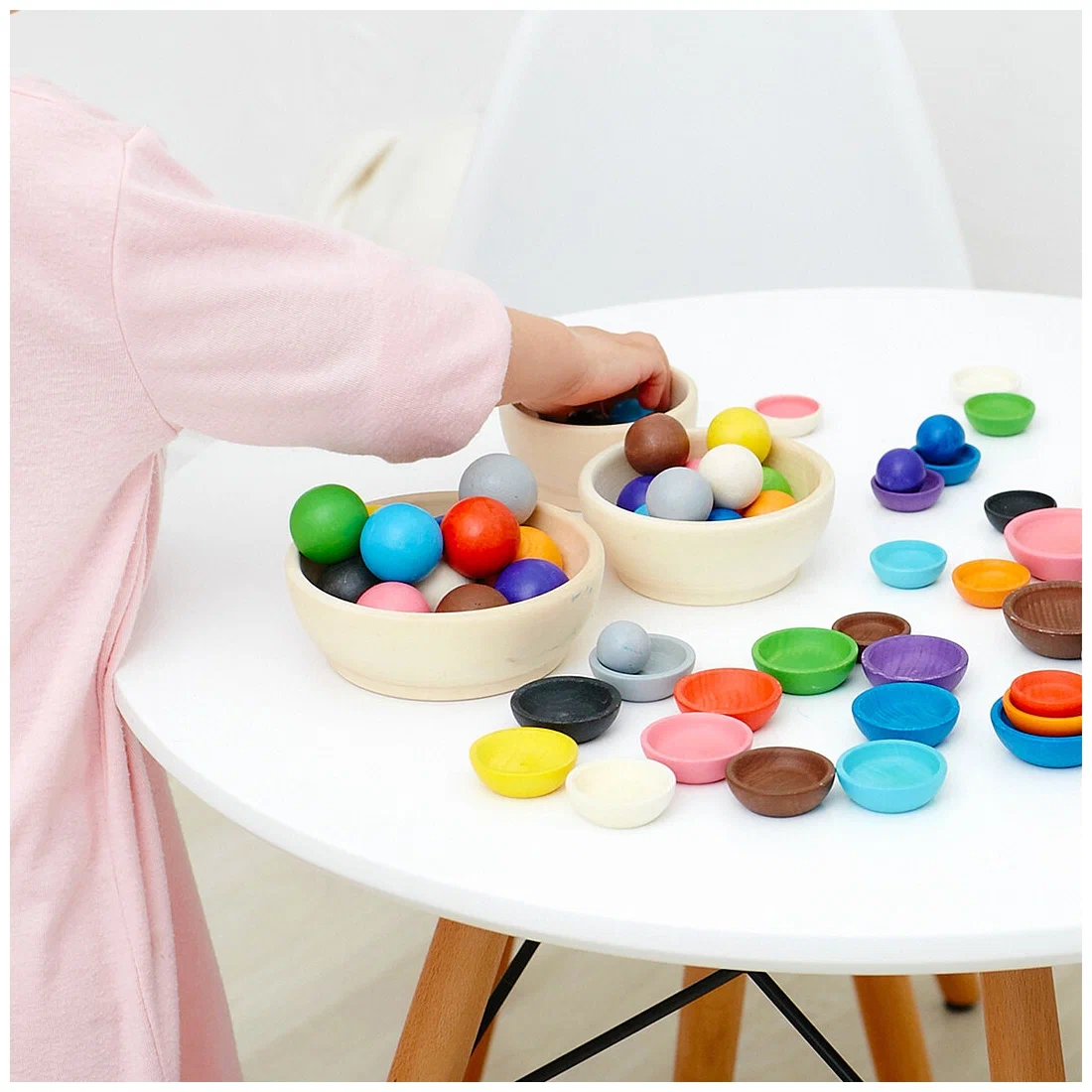
Colour Sorting Tray
The defining Montessori activity of the two year old period. Colour-matched wells and sorting objects let a child confirm their understanding of colour names through action rather than recitation.

Wooden Unit Blocks
The most versatile Montessori material for 3 year olds. Every piece is a precise fraction or multiple of every other piece, teaching spatial reasoning and early geometry through building.
Common questions about Montessori toys
What makes a toy Montessori?
A Montessori toy has a single clear purpose, uses simple natural materials, invites hands-on exploration and lets a child practise one skill at a time without adult direction. It is self-correcting, meaning the child can see for themselves when something is wrong, without an adult pointing it out. The child creates every action: nothing happens until the child makes it happen.
Are Montessori toys just wooden toys?
No. Wood is the most common material in Montessori-aligned toys because it is durable, tactile, weighted and warm to the touch, but material alone does not make a toy Montessori. A wooden toy can still be passive, battery-powered or have no clear developmental purpose. Equally, a well-designed cotton sensory toy or natural rubber ball is more aligned with Montessori principles than a poorly designed wooden one.
At what age should you start Montessori toys?
From birth. Newborns benefit from high-contrast visual mobiles placed within their visual range. Babies from 4 months benefit from simple rattles and sensory balls. From 6 months, object permanence toys and stacking materials are appropriate. The Montessori approach spans from birth through adolescence, with different materials at each stage. There is no minimum age to begin.
Do Montessori toys have to be expensive?
No. Some of the most effective Montessori materials cost under $30. An object permanence box, a set of knob puzzle pieces, a coin box or a colour sorting tray are all available on Amazon AU for under $45, and each provides months of genuine developmental engagement. The price of a toy is not an indicator of its Montessori quality. Simplicity is the defining feature, and simplicity is not expensive to produce.
Can a toy be both Montessori and electronic?
In the strict sense, no. Electronic toys that make sounds, give verbal praise or light up when a child succeeds shift the attention from the child's own developing sense of competence to an external reward. Montessori pedagogy is built on intrinsic motivation: a child succeeds because they have genuinely understood something, not because a device played a jingle. That said, not all screen-based learning is developmentally harmful; the Montessori critique applies specifically to toys where the electronic element substitutes for genuine physical engagement and self-correction.
How many Montessori toys should a child have at once?
Six to ten toys visible on a low shelf at any one time is the range most Montessori educators recommend across the 1 to 4 age period. Fewer options means more focused engagement with each activity. Toy rotation, cycling four or five toys out every one to two weeks and replacing them with ones previously stored away, maintains novelty and re-engagement without requiring additional purchases. The shelf itself is part of the preparation: an ordered, accessible, child-height shelf is as important as the toys on it.
What is the difference between Montessori and Waldorf toys?
Both emphasise natural materials and child-led play, but they differ in approach. Montessori materials tend to be precise, realistic and purposeful: each one isolates a specific skill. Waldorf toys tend to be more open-ended, simple in form (a piece of driftwood, a silk scarf, a simple doll) and fantasy-oriented. Montessori favours realistic representations of real objects; Waldorf encourages a child's imagination to fill in the detail. Many families draw from both traditions without contradiction.
The short version
A Montessori toy is one that: lets the child create every action, has one clear purpose, uses simple natural materials and gives the child feedback without adult correction.
The label does not guarantee anything. A plastic sorting cube with ten sounds and a flashing light can carry the Montessori label. A simple smooth wooden coin box without any label can be more genuinely Montessori than almost anything on the market.
The principles matter more than the price, brand or packaging. Use the checklist in this article to evaluate any toy before you buy it, labelled Montessori or not.
For specific picks by age, the guides below cover the developmental context in detail alongside our top eight recommendations for each stage.
About this article: This is an informational guide. No affiliate links are present in this article. Links to product pages on ToyBloom go to our own guides, which do contain affiliate links to Amazon AU. As an Amazon Associate we earn from qualifying purchases when readers click through from those pages.