Best Montessori Puzzles for Toddlers in Australia
The best toddler puzzle is not the one with the highest piece count. It is the one that creates a clear, manageable problem the child can partly solve, repeat and gradually master.
Increase one part of the challenge at a time
Piece count matters, but it is only one variable. A five-piece puzzle with subtle shapes can be harder than a twelve-piece puzzle with large obvious visual cues.
Start simple
Large inset pieces, strong shape cues and a stable board.
Add more choices
Increase the number of pieces while keeping the picture or recesses easy to read.
Remove supports
Move from large knobs to chunky pieces, then to interlocking pieces when appropriate.
Add content
Animals, maps, lifecycles and geometry can become meaningful once the puzzle task itself is manageable.
What makes a good toddler puzzle
A useful puzzle gives clear feedback, fits the child's current ability and remains physically easy to handle.
Good signs
- The child can clearly see where pieces might belong.
- Pieces are large enough for the product's age grade.
- The board or frame stays stable during use.
- Difficulty can be adjusted by offering fewer pieces.
- Images and shapes are clear rather than visually cluttered.
- The product has clear age and safety information.
Red flags
- Very small or thin pieces for young toddlers.
- Loose knobs or parts that can detach.
- Overly busy artwork that hides the matching cues.
- A puzzle chosen only because the box says it suits the child's age.
- Flaking paint, rough edges or damaged board surfaces.
- Electronic rewards that distract from the puzzle itself.
Six Montessori puzzles at a glance
These picks cover first puzzles, animal jigsaws, peg boards, symbol matching, a magnetic maze and more advanced pattern building.
| Pick | Best for | Style | Challenge |
|---|---|---|---|
| 2 Toddler Toys Puzzle Set | First puzzles | Two wooden inset boards | Gentle start |
| Springflower Animal Set | Picture variety | Six wooden jigsaws | Easy to moderate |
| Number, Letter and Shape Set | Symbol matching | Three peg boards | Easy to moderate |
| OundarM 4 Pack | Grasping and placement | Four peg boards | Gentle start |
| 142 Piece Pattern Blocks | Older preschoolers | Blocks, sticks and cards | Higher challenge |
| Magnetic Colour and Number Maze | Contained travel play | Magnetic maze board | Moderate |
Find the right puzzle style
Choose the kind of play you want. This is a practical starting point, not a developmental test.
Start with a simple inset or peg puzzle
Choose the 2 Toddler Toys set or OundarM boards. Offer one board at a time and reduce the number of pieces if needed.
Choose a multi-puzzle pack
The Springflower set offers six animal pictures, while the number, letter and shape set changes the matching cue across three boards.
Keep the pieces attached
The magnetic maze contains its pieces inside the board, making it useful when loose jigsaw pieces are inconvenient.
Move into pattern construction
The 142 piece set adds model cards, geometric blocks and sticks for children ready to build beyond a fixed inset board.
From first fit to open pattern building
Piece count is only one part of difficulty. Handles, visual cues, borders and whether a model is provided all change the task.
Relative challenge ladder
This editorial scale compares puzzle styles, not a child's ability.
If every step needs adult correction, simplify the activity. If completion is immediate every time, add one new challenge.
The best Montessori puzzles for different kinds of play
We compared task clarity, adjustability, loose-piece management and the type of matching each puzzle invites. These are Montessori-style retail toys, not formal Montessori classroom materials.
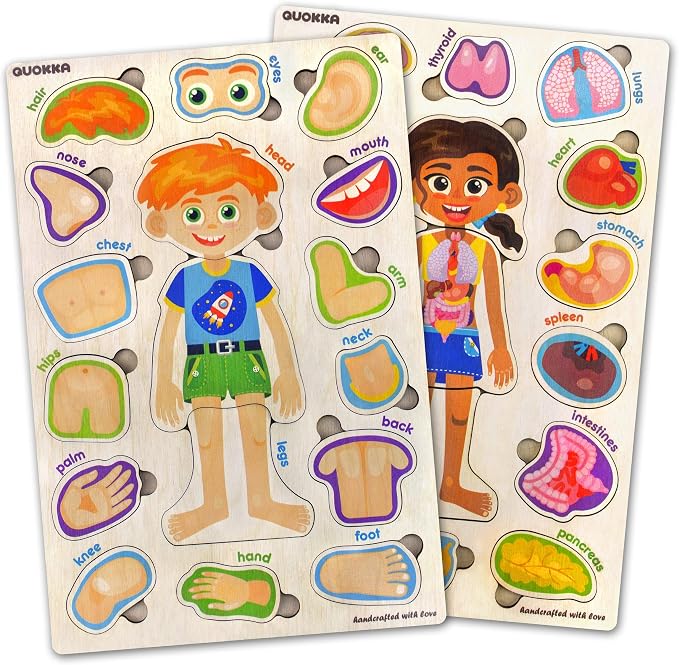
2 Toddler Toys Wooden Montessori Puzzle Set
This two-puzzle set is a straightforward place to begin. A limited choice of pieces helps a new puzzler focus on comparing shapes, turning a piece and finding its matching space.
- Simple first-puzzle format
- Two boards for repeat play
- Easy to offer fewer pieces
- Clear fit-and-place goal
Keep in mind: Check the current listing for exact dimensions, included designs and age grading.
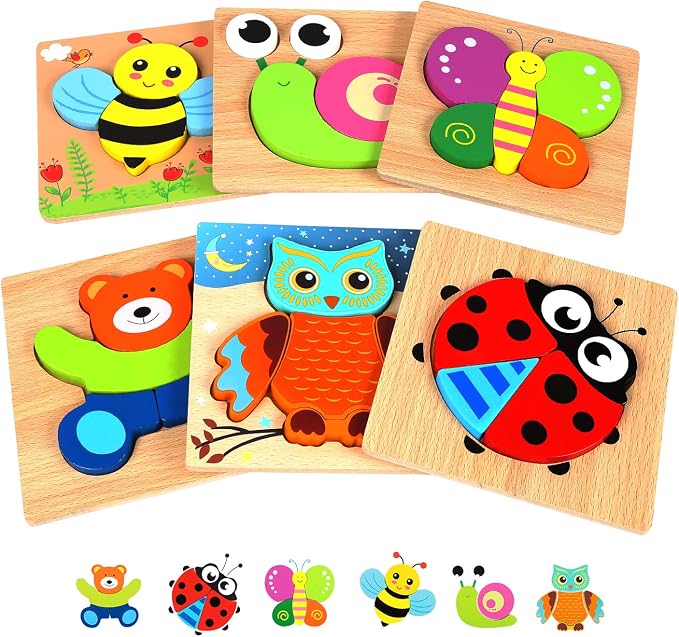
Springflower 6 Pack Wooden Animal Jigsaw Puzzle Set
Six animal puzzles provide more variety than one board. Familiar pictures also invite natural conversation about animals, colours and where a piece belongs.
- Six separate animal designs
- Useful for rotating activities
- Introduces joined-piece puzzles
- Invites animal vocabulary
Keep in mind: Do not mix all six puzzles until the child can sort the sets confidently. Confirm piece size and age guidance.

Wooden Number, Letter and Shape Peg Puzzle Set
This three-board set combines lifting and placing with numbers, letters and geometric shapes. Younger children can use each board as a visual matching task, with names added naturally as interest develops.
- Number, letter and shape boards
- Pegs support lifting pieces
- One board can be offered at a time
- Creates chances for naming
Keep in mind: Fitting a symbol does not prove understanding. Check that every peg stays firmly attached.
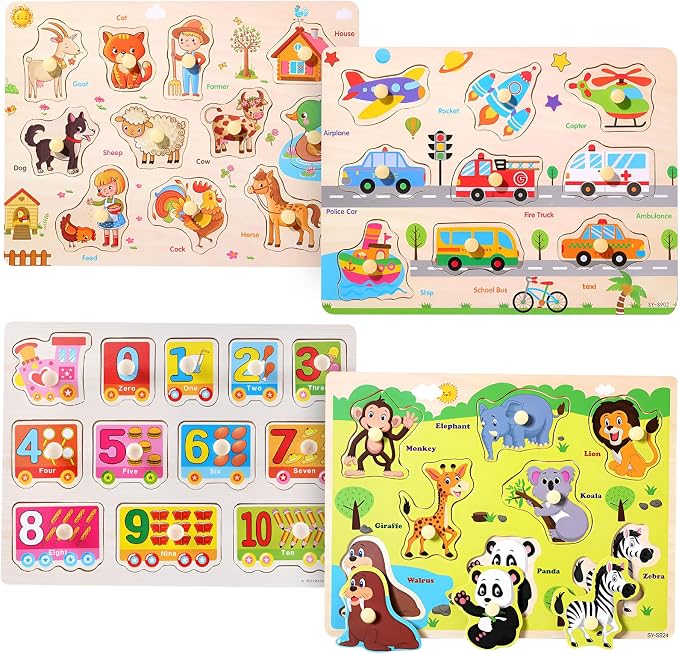
OundarM 4 Pack Wooden Peg Puzzle Boards
This four-board set centres on the familiar routine of grasping, lifting, comparing, rotating and placing. Pegs may be easier to pick up than flat pieces.
- Four boards in one set
- Peg grip for lifting
- Clear repeated routine
- Easy to scale the choices
Keep in mind: Stop using a board if a peg loosens, wood splinters or the surface coating chips.

142 Piece Wooden Pattern Blocks and Smart Sticks
This large set moves beyond one correct recess. Children can copy a model card, combine sticks and shapes or create a new picture.
- Model copying and free building
- Multiple geometric pieces
- High replay variety
- Complexity can increase gradually
Keep in mind: Many small pieces make this unsuitable as a first toddler puzzle. Follow the age grade and supervise.

Magnetic Colour and Number Maze
A magnetic maze changes the action from lifting loose pieces to guiding them through enclosed paths toward matching areas.
- Contained pieces during normal use
- Colour and number cues
- Compact all-in-one board
- Useful away from home
Keep in mind: Inspect the clear cover and frame. Stop use if the board opens or any magnet becomes accessible.
Puzzle pieces can be small, so age grading and construction matter
Use the individual product's own age guidance and inspect pieces regularly, especially for younger toddlers.
Australian Government toy-safety guidance
Product Safety Australia publishes guidance for children's toys and a mandatory standard for toys intended for children up to and including 36 months. This is especially relevant when puzzle knobs, pegs or small pieces can detach.
Inspect knobs, pegs and coatings
Wooden puzzles can develop loose knobs, chipped coatings or splintered edges with wear. Remove damaged pieces from use and follow the manufacturer's cleaning and care guidance.
What the evidence supports about puzzle play
Puzzles are best described as opportunities to practise matching, orientation, trial and error and visual organisation, not as guaranteed cognitive training.
Play offers repeated practice
The American Academy of Pediatrics describes play as important for development and caregiver-child interaction. Puzzles can fit within active play, but that does not mean one puzzle guarantees gains in executive function, spatial reasoning or school readiness.
Early puzzle play has been linked with later spatial skill
A longitudinal study observed 53 parent-child pairs and found an association between puzzle play from 26 to 46 months and later performance on a spatial transformation task. Because the study was observational, it does not prove that a particular puzzle caused the result.
Australian guidance includes puzzles as quiet play
The Australian Government lists puzzles among quiet activities for infants, toddlers and preschoolers when they are not engaged in active play. A puzzle belongs within a varied day, not as a replacement for movement, conversation or free play.
What this page can responsibly evaluate
ToyBloom can compare puzzle clarity, piece size, visual cues, durability, adjustability and age fit. It should avoid claims that a product directly creates neural representations, writing readiness or executive-function gains.
Age bands and piece counts are only rough starting points. A child's previous puzzle experience can matter as much as age. If the child repeatedly needs full adult completion, simplify the puzzle rather than treating the difficulty as a developmental test.
How to choose the right puzzle difficulty
Use these six checks before moving to a harder puzzle.
1. Watch how the child starts
If they immediately understand where several pieces might go, the puzzle is probably within reach. If the whole board is confusing, simplify it.
2. Change one variable at a time
Add more pieces, smaller pieces or less obvious visual cues gradually rather than increasing everything together.
3. Use fewer pieces when needed
You do not have to present the full puzzle. Offer three or four pieces first, then add more as the child succeeds.
4. Consider image complexity
Clear, distinct pictures can be easier than subtle illustrations even when the piece count is the same.
5. Check physical handling
Large knobs, chunky pieces and sturdy frames may matter more than the theme for a younger toddler.
6. Stop using piece count as a milestone
There is no universal rule that a two-year-old must solve a specific number of pieces. Progress is individual.
Frequently asked questions about toddler puzzles
Direct answers without rigid milestone claims.
What is a good first puzzle for a toddler?
A simple inset puzzle with a few large pieces. Large knobs or chunky pieces can make lifting easier, and the board should stay stable while the child works.
How many puzzle pieces should a 2 year old do?
There is no universal piece count. Puzzle experience, piece size, image complexity and frame support all matter. Start with a puzzle the child can partly solve and increase complexity when it becomes easy.
Are wooden puzzles better for toddlers?
Not automatically. Wood can be durable and stable, but piece size, clarity, construction, age grading and difficulty matter more than material alone.
Are puzzles Montessori?
Some puzzle designs align well with Montessori principles, but not every puzzle sold as Montessori is a classic Montessori material. Clear feedback, purposeful repetition and appropriate challenge matter more than the label.
When should I move my child to harder puzzles?
When the current puzzle is completed easily and repeatedly without much trial and error. Increase one part of the challenge at a time.
Do puzzles help with writing readiness?
A puzzle can involve grasping, rotating and placing pieces, but it should not be presented as direct handwriting training. Writing development depends on a much broader set of motor, language and learning experiences.