
Best Montessori Toys for Gross Motor Skills in Toddlers
Gross motor skills involve large-body movements such as walking, climbing, balancing, pushing, pulling, throwing and changing position. The best toys give children a clear movement challenge without turning normal physical development into a scorecard.
Four movement experiences these toys can offer
These are practical descriptions of play, not claims that one product will produce a specific developmental outcome.
Changing body position while using hands and feet on rungs, arches or ramps.
Moving over low foam shapes, ramps and changing surfaces.
Starting, repeating and stopping a controlled movement.
Propelling a ride-on while steering and controlling speed.
Gross motor toys create movement opportunities
Climbing, crawling, pushing and riding involve many parts of the body. They can offer useful active play without promising a specific milestone or later academic skill.
What this page can responsibly say
- Large-body movement and hand use are both parts of overall physical development.
- Climbing, pushing and balancing involve trunk, arm and leg control.
- Children can benefit from varied opportunities to move and manipulate objects.
- Different movement tasks can be made easier or harder as ability changes.
What it should not claim
- That core strength must be mastered before finger control can develop.
- That a Pikler triangle prepares a child for writing.
- That wooden equipment prevents tipping better than plastic by default.
- That gross-motor equipment reduces anxiety by a fixed percentage.
- That a milestone checklist can diagnose readiness for a specific toy.
The 8 gross-motor picks at a glance
These real products cover climbing, crawling, sliding, rocking, bouncing, foot-powered riding and steering. Choose the movement and setup that suit the child and your available space.
| Pick | Best for | Age guidance | Check before buying |
|---|---|---|---|
| 7-in-1 wooden climbing set | Climbing and adjustable routes | Confirm current listing | Assembly, locks and space |
| BABY JOY foam play set | Crawling and low climbing | Toddler use, confirm listing | Seams and non-slip setup |
| Pikler indoor playground set | Climbing, ramps and body-position changes | Ages 1 to 3, per supplied title | Dimensions and hardware |
| OLAKIDS foam climbing set | Reconfigurable crawl-and-climb play | Toddler use, confirm listing | Cover condition and floor grip |
| 5-in-1 rocking horse | Rocking, balancing and ride-on play | Ages 1 to 3, per supplied title | Mode conversion and stability |
| Giraffe bouncy hopper | Bouncing and upright balance | Ages 2+, per supplied title | Inflation and clear floor space |
| Scuttlebug Beetle | Foot-powered riding and steering | Ages 1 to 3, per supplied title | Seat fit and wheel condition |
| Little Tikes Cozy Coupe | Foot-to-floor or parent-push riding | 18 months to 5 years, per supplied title | Assembly and riding area |
8 Montessori-style toys for gross-motor play
The selection focuses on movement variety, setup, adjustability, stability, supervision and whether the child can control the action at a comfortable pace.
The toy has an obvious physical action such as climb, rock, step, push, ride or toss.
Height, spacing, distance or complexity can be reduced.
The equipment must stay predictable on the surface where it is used.
Age grading, supervision, fall zones, hardware and weight limits come before developmental claims.

7-in-1 Foldable Wooden Climbing Set
This multi-piece set combines a climbing triangle, ramp and related elements that can create several crawling, climbing and sliding routes.
- climbing
- crawling
- route changes
- child-controlled pace
Safety check: Confirm assembly, locks, dimensions, load limit, surface requirements and supervision guidance. Keep it away from stairs, hard edges and unsafe fall zones. Compare more choices in the toddler climbing toy guide.

BABY JOY 5-Piece Crawl and Climb Foam Play Set
Five foam shapes can be arranged into low routes for crawling over, climbing up, stepping across and sliding down.
- crawling
- low climbing
- stepping
- adjustable layouts
Safety check: Use active supervision. Check the covers, seams and foam for damage, and place the pieces on a non-slip surface away from stairs and hard furniture.
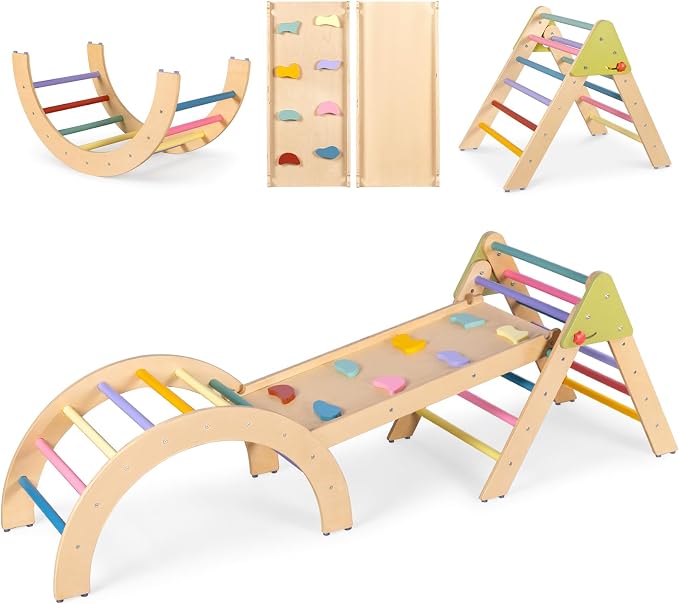
Pikler Triangle Indoor Playground Set
This wooden indoor playground gives toddlers a fixed structure for climbing, stepping, crawling and changing body position at their own pace.
- climbing
- body-position changes
- self-paced movement
- indoor active play
Safety check: Confirm the current age grade, dimensions and weight limit. Check every rung, joint and fastener before use and follow the manufacturer's surface and supervision guidance.
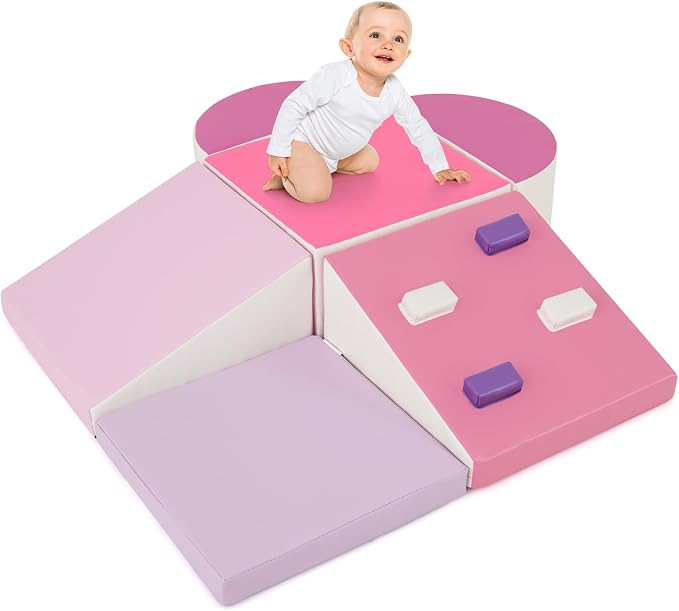
OLAKIDS 6-Piece Foam Climbing Set
Six foam blocks provide more layout options for crawling, climbing, stepping and sliding while keeping the course low to the floor.
- crawling
- climbing
- sliding
- reconfigurable play
Safety check: Confirm the current product guidance and load limit. Inspect the PU covers, zips and seams, and use the set only on a clean, dry, non-slip floor.

5-in-1 Rocking Horse and Ride-On Toy
This convertible toy combines rocking, balancing, ride-on, push-walker and ball-play modes in one larger piece of equipment.
- rocking
- riding
- pushing
- several play modes
Safety check: Confirm the current instructions, age range, weight limit and conversion steps. Check stability in every mode and use on a level surface away from stairs.
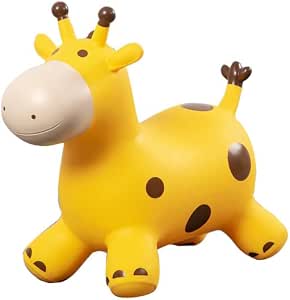
Giraffe Bouncy Horse Hopper
This inflatable ride-on lets a child hold the ears, keep the feet on the floor and create repeated bouncing movement.
- bouncing
- upright balance
- leg-powered movement
- indoor active play
Safety check: Follow the supplied inflation and weight instructions. Check for leaks or surface damage and keep the play area away from stairs, sharp objects and hard edges.
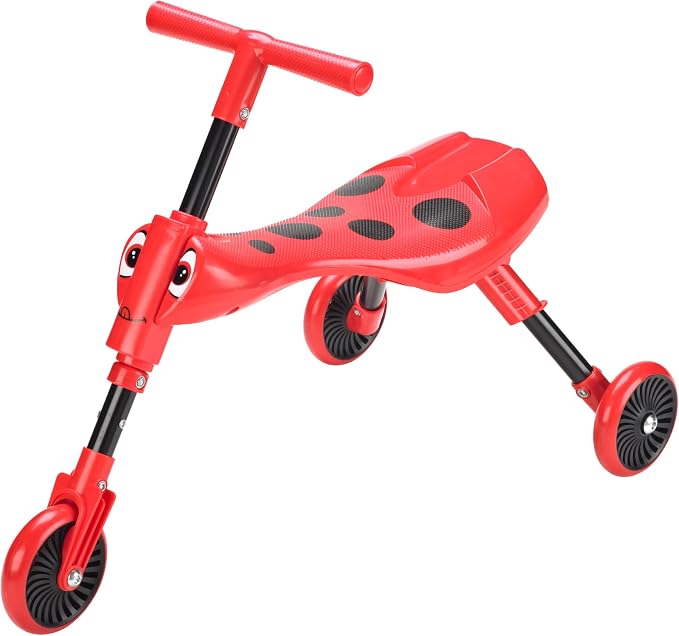
Scuttlebug Beetle Three-Wheel Ride-On
The three-wheel design gives toddlers a compact way to push with their feet, steer and stop while seated.
- foot-powered riding
- steering
- starting and stopping
- compact storage
Safety check: Confirm the current age and weight limits, assembly and wheel condition. Keep riding away from stairs, roads, pools, slopes and uneven surfaces. Compare more models in the toddler ride-on toy guide.
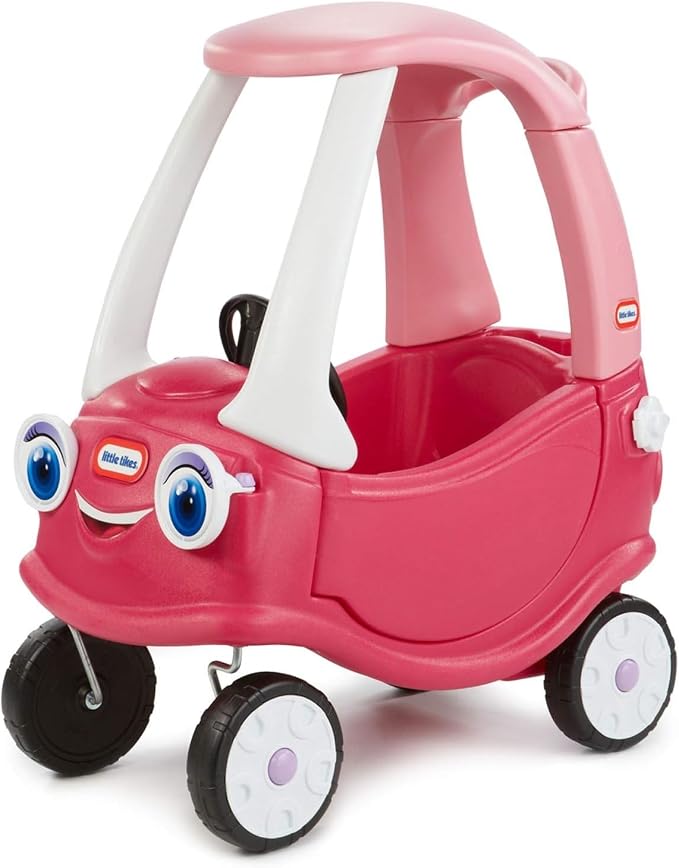
Little Tikes Princess Cozy Coupe
This ride-on can be used in parent-push or foot-to-floor mode, allowing the adult's role to change as the child's control develops.
- parent-push option
- foot-to-floor riding
- steering
- indoor or outdoor use
Safety check: Confirm assembly, floorboard setup, current age and weight limits. Use on a level area away from vehicles, roads, pools, stairs and steep slopes.
Australian safety guidance for active-play toys
Gross-motor equipment can involve falls, tipping, moving parts and higher physical forces, so setup and inspection matter.
Use the exact product guidance
Product Safety Australia publishes general guidance for children's toys and a mandatory standard for toys intended for children up to and including 36 months. For climbing and balance toys, also follow the manufacturer's setup, supervision, weight-limit and surface instructions.
Kids' toys guide
Mandatory standard for toys up to 36 months
Product recalls
Inspect active equipment before use
Check hinges, locking mechanisms, wheels, ropes, pegs, rungs, laminated boards and non-slip surfaces. Remove equipment from use if joints loosen, surfaces crack or the product no longer sits securely.
What the evidence supports
The strongest message is that children benefit from active play and varied movement opportunities. It is not that one piece of equipment produces a guaranteed neurological or developmental gain.
Active play matters
The American Academy of Pediatrics describes play as important for development and caregiver-child interaction. Movement-based play fits within that broad picture, but an individual balance board or climber should not be treated as a developmental intervention.
Montessori-inspired movement should still be child-led
Montessori principles emphasise independence, purposeful activity and an environment scaled to the child. For gross-motor play, that supports giving children appropriate opportunities to move without forcing performance or competition.
Vestibular and proprioceptive language needs care
Rocking, climbing, pushing and stepping involve movement, body position and force. That does not make every gross-motor toy a sensory-therapy tool. Therapy claims require much stronger evidence and individual assessment.
What this page can responsibly evaluate
ToyBloom can compare movement type, adjustability, setup, construction, supervision needs and age fit. It should avoid claims that equipment increases motor-planning efficiency, reduces anxiety or strengthens specific sensory systems by a measurable amount.
How to choose a gross-motor toy
If they climb everything, choose a low climbing structure. If they love pushing, a stable walker may be more useful.
Climbers, beams and ride-ons need enough space for approach, movement and possible falls.
Closer stepping stones, shorter beams and lower climbing options make progression easier.
Hinges, locks, wheels and joints matter more than whether the material is wood or plastic.
Readiness is product-specific and child-specific. Use the manufacturer's guidance and close supervision.
The child does not need to “train” balance, core strength or agility. Enjoyable movement is enough.
Related ToyBloom guides
Frequently asked questions
Direct answers without therapeutic or milestone overclaims.
What are gross motor skills?
Gross motor skills involve large-body movements such as walking, climbing, balancing, pushing, pulling, throwing and changing position.
What toys are good for gross motor play indoors?
Useful options include low climbing structures, balance boards, stepping stones, push walkers, low balance beams, ring-toss sets, climbing arches and appropriately sized ride-on toys.
Do gross motor toys directly improve fine motor skills?
Gross and fine motor development are related parts of overall physical development, but a gross-motor toy should not be presented as directly causing better handwriting, scissor use or finger dexterity.
What is the difference between vestibular and proprioceptive input?
Vestibular information relates to movement and head position relative to gravity, while proprioceptive information comes from muscles and joints about body position and force. Toys can create movement experiences involving both, but they are not therapeutic devices by default.
At what age can a toddler use a balance board or Pikler triangle?
There is no single age that applies to every product or child. Follow the exact manufacturer's age guidance, the child's current movement abilities and close supervision.
Are wooden gross motor toys safer than plastic ones?
Not automatically. Safety depends on the complete product, stability, construction, setup, age fit and use. Material alone does not determine safety.