
Best Montessori Toys for Independent Play in Toddlers
Independent play is not a test of how long a toddler can stay quiet. It is the gradual ability to choose or accept an activity, understand what to do, repeat an action, work through small problems and rely less on adult direction while a caregiver remains nearby and available.
What independent play actually looks like
For toddlers, independence is usually partial. A child may need help starting, then continue alone. They may play independently for a short stretch, return to you, and go back again. That still counts.
A caregiver can remain in the room, keep hazards under control and still avoid directing every action.
Posting the same disc twenty times or opening the same latch repeatedly can be exactly what makes an activity manageable and self-directed.
There is no research-backed rule that every 18-month-old should play alone for a fixed number of minutes. Interest, familiarity and environment matter.
Use this five-step progression instead of age-based focus targets
This is a practical way to decide whether an activity is becoming more independent without turning play into a performance score.
Notice
The child is interested enough to approach, touch or watch a brief demonstration.
Understand
The child understands the basic action: post it, turn it, thread it, move it or open it.
Repeat
The child can perform the loop again without receiving a fresh instruction every time.
Recover
A small error does not immediately end the activity. The child experiments, resets or accepts a small amount of help.
Return
The activity remains familiar enough that the child may choose it again later with less setup from you.
Try a less crowded play space
A controlled study of 36 toddlers aged 18 to 30 months compared play sessions with four toys versus sixteen. With four toys available, toddlers played with each toy for longer and used toys in a greater variety of ways.
Do not measure success by minutes
Instead of asking “Did they play alone for 30 minutes?”, look for small signs that adult direction is decreasing.
Eight ToyBloom picks for independent play
These real products offer repeatable activities that can be simplified or extended. Always confirm the current listing, age grade, contents and warnings.
| Product | Independent-play loop | Age guidance | Check before buying |
|---|---|---|---|
| BOHS Caterpillar Lacing Toy | Choose bead → thread → pull through → repeat | Confirm current listing | Bead size and cord condition |
| YOLOMOON Sensory Busy Cube | Choose feature → move or press → observe → repeat | 6 months to 3 years, per supplied title | Attached parts and fasteners |
| Two-Piece Wooden Puzzle Set | Choose piece → orient → fit → remove → repeat | Ages 2 to 4, per supplied title | Piece size and finish |
| SMART Safari Animals | Choose challenge → arrange pieces → check → revise | Confirm current listing | Challenge level and piece size |
| Farm Screwdriver Board | Choose fastener → align tool → turn → reset | Ages 3+, per supplied title | Every removable component |
| 14-Piece Sensory Bin Tool Set | Scoop or grasp → transfer → release → repeat | Confirm current listing | Tool size and chosen filler |
| Zonon Lacing Cards | Choose card → guide lace → pull through → continue | Confirm current listing | Cord condition and card edges |
| Interlocking Building Blocks | Choose pieces → connect → test → revise | Confirm current listing | Small-piece suitability |
A better selection method than “this toy keeps toddlers busy”
Independent-play value depends on the interaction between the child, the activity and the setup. These four factors matter more than a marketing label.
The child can tell what to do after a short presentation.
The activity can be done again without needing a new adult prompt.
The material shows something about fit, movement, sequence or completion.
The activity can be prepared again without a complicated adult-only setup.

BOHS Caterpillar Lacing Toy
The loop is easy to understand after a short demonstration, and the child can repeat it without needing a new instruction each time.
Bilateral hand use, visual aiming, pulling and sequencing.
Start with only three or four large beads. Lay the lace and beads on a small tray so the beginning and end of the task are obvious.
If the child cannot get the lace through the first hole, hold the bead steady once, then step back. Avoid completing the whole sequence for them.
Large beads and cord length matter. Follow the actual product age grade and keep loose pieces away from children who still mouth objects.
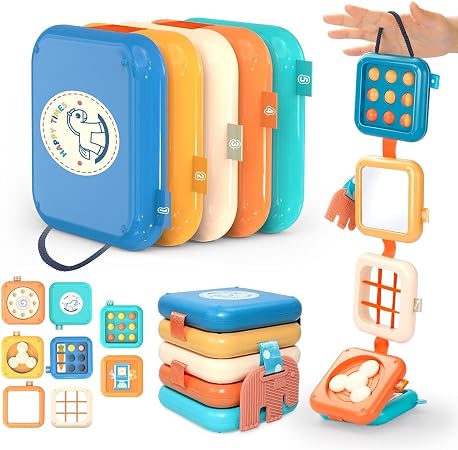
YOLOMOON Sensory Busy Cube
A compact busy cube offers several attached activities without requiring loose pieces spread across the floor. A child can return to one familiar feature instead of completing every side.
Turning, pressing, pulling and noticing what each action changes.
Place the cube within easy reach and begin with one visible feature rather than demonstrating every side.
Show one slow action, then pause. Let repetition come from the child.
Inspect every attached feature, cord and fastener. Stop using the cube if anything loosens.
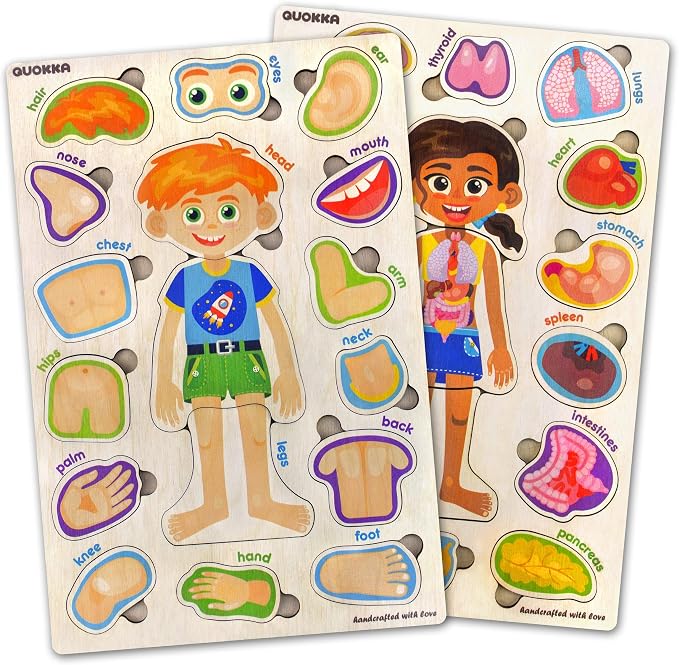
Two-Piece Wooden Montessori Puzzle Set
Two separate puzzles let the adult offer one manageable task at a time. Each piece gives physical feedback when its shape and orientation match the space.
Shape matching, rotation, placement and completing a visible whole.
Offer one board first and place only its matching pieces beside it.
Point out one edge or turn the board, but leave the final placement to the child.
Confirm the current age grade and piece size. Inspect the wood, joins and finish for damage.
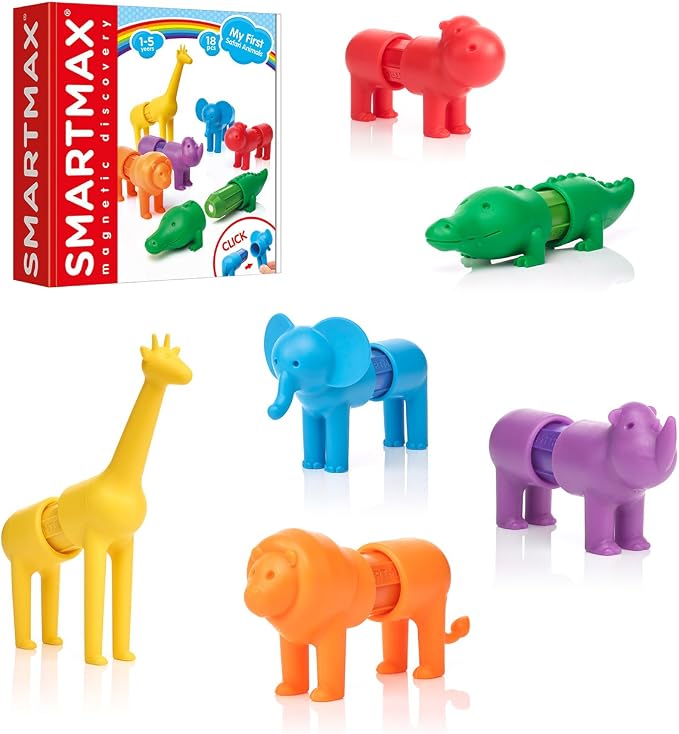
SMART Games My First Safari Animals
The animal pieces support free handling first, then visual challenges that can be repeated or changed as the child becomes familiar with the set.
Visual comparison, orientation, placement and revising an arrangement.
Begin with free animal play, then offer the easiest challenge and only the pieces it needs.
Ask what looks different from the card instead of moving a piece for the child.
Confirm the current age grade and piece dimensions. Store all pieces together and remove damaged parts.

Wooden Farm Screwdriver Board, 16 Pieces
The task can become highly self-directed once the child understands the tool and fastener, but it is much more complex than a coin drop or peg board.
Tool handling, rotation, alignment and persistence with a multi-step task.
Use one tool and one or two farm pieces at first. Keep every removable component in a controlled tray.
Model tool alignment once. If the tool slips, help reset the tool rather than finishing the turn.
Count all sixteen pieces after play. Inspect the tool and fasteners, follow the exact age grade and store the set away from younger children.

14-Piece Wooden Sensory Bin Tool Set
Tongs, spoons, bowls and other tools can create repeatable scooping, grasping, pouring and transferring activities with one carefully chosen material.
Squeeze and release, visual aiming, controlled transfer and optional colour sorting.
Choose one tool, one bowl and one age-appropriate material. Add choices only after the first loop is familiar.
If objects roll away, reduce the quantity or use a tray with a raised edge. Do not correct every colour choice.
Choose fillers for the child's age and mouthing behaviour. Supervise directly and store all fourteen tools after play.
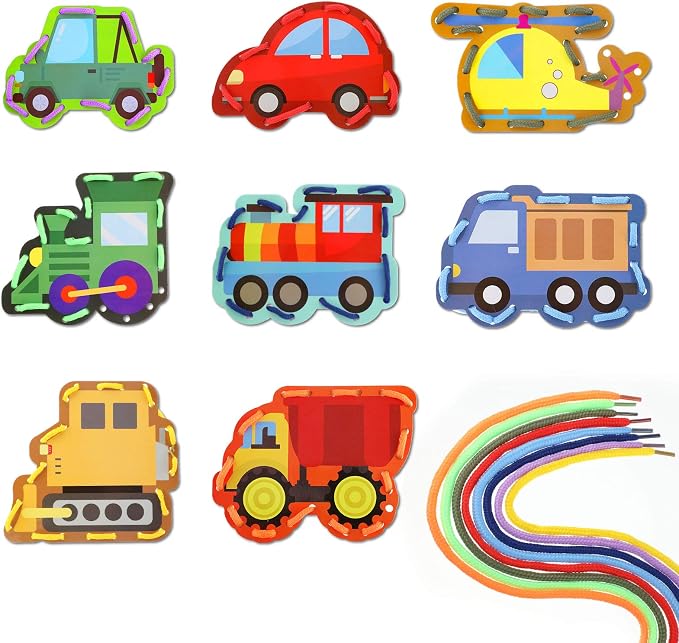
Zonon Transportation Lacing Cards
Eight transportation patterns give the child a familiar threading action with a visible route around each card.
Visual aiming, pulling, two-hand use and following a route.
Offer one card with the lace already passed through the first hole.
Hold the card steady once or point to the next hole, then allow the child to continue.
Inspect the cord and card edges before use. Follow the current age guidance and supervise lacing activities.
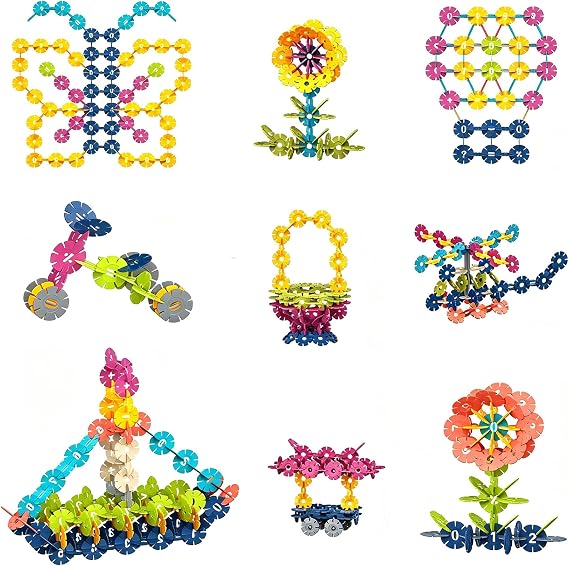
240-Piece Interlocking Building Blocks
Interlocking pieces allow many possible structures, so the child can repeat a simple joining action or build a longer self-directed project.
Connecting, planning, testing stability and changing a design.
Offer a small tray of pieces first rather than all 240 components.
Show one secure connection, then let the child decide what to build and how to change it.
The set contains many small pieces. Confirm the current age grade and keep every component away from younger children.
What research says, and what a toy page should not pretend it says
This distinction is important for both parents and SEO credibility. Strong-sounding numbers are not automatically evidence.
Montessori supports independence through the environment
The Association Montessori Internationale describes prepared environments with accessible materials, child choice, hands-on activity, observation and increasing independence. That supports the idea of arranging the environment so children can do more for themselves.
“Control of error” is a design principle, not a brain claim
Montessori materials often allow children to notice a mismatch through the activity itself. That can reduce adult correction. It does not prove that every self-correcting toy builds executive function or creates a neurological “flow state.”
Electronic toys need nuanced wording
In a study of 26 parent-infant pairs, electronic-toy play was associated with fewer adult words, conversational turns, parent responses and child vocalisations than traditional-toy or book conditions. That is a specific communication finding, not proof that all electronic toys are harmful or that wood is automatically superior.
Montessori school research is not product evidence
Studies of Montessori education evaluate a much larger system: teachers, environment, work cycles, peer groups, curriculum and materials together. They should not be used to claim that one Amazon toy independently improves attention, maths or self-regulation.
How to read developmental toy claims
A useful product description should explain what the child can actually do with the toy and what an adult should check before use.
Independent play still needs active safety management
Several products on this page contain components that deserve extra attention, including beads, laces, tools, puzzle pieces, sensory-bin materials and small construction parts.
For young children, small detachable components can create choking hazards. This matters especially for beads, puzzle pieces, fasteners, sensory fillers and construction parts.
Australian standard for toys up to 36 months →Busy cubes, screwdriver boards and wooden toys need regular inspection. Remove any activity if a fastener loosens, wood splits or an attached feature becomes detachable.
Kids' toys safety guide →A toy can be recalled after purchase. Recheck marketplace toys, gifts and second-hand items, particularly if the supplier or exact model is unclear.
Search Australian recalls →Choose fillers according to age and mouthing behaviour. Direct supervision is needed when a setup includes loose materials.
Lacing toys should use age-appropriate cord lengths and pieces. Inspect cords for fraying and supervise even when the child performs the task independently.
Do not assume that every listing with the same product name has the same dimensions, finish, fasteners or age grade. Check the exact item you are buying.
A simple independent-play setup for home
You do not need a showroom-perfect Montessori shelf. You need an environment where the child can see what is available, start safely and put the activity back with reasonable help.
Prepare
- Display fewer materials instead of every toy you own.
- Keep each activity complete and ready to use.
- Put loose pieces in a shallow tray or bowl.
- Separate easy, familiar activities from newer challenges.
- Remove broken or incomplete toys immediately.
Present, then step back
- Demonstrate briefly and slowly.
- Use less language when the movement itself is clear.
- Do not praise every successful repetition.
- Wait before helping with a small problem.
- Give the least help that lets the child continue.
Observe
- Which toy do they return to?
- Which step causes frustration?
- Do they understand the loop?
- Can you reduce pieces rather than replacing the toy?
- Is the child still interested after several days?
Rotate for clarity, not novelty
- Rotate when the shelf is crowded or several items are ignored.
- Keep favourite activities available long enough for mastery.
- Do not remove a toy just because the child repeats it.
- Bring back stored items later in a simpler or more advanced setup.
- Use your observations, not a rigid calendar.
Independent play FAQs
These answers deliberately avoid fixed-minute expectations and one-toy developmental guarantees.
How long should a toddler play independently?
There is no evidence-based minute target that every toddler should meet. Independent play varies with age, temperament, familiarity, sleep, hunger, environment and the activity itself. A better goal is to notice whether your child can start a familiar activity, stay with it for a while, and gradually need less adult help.
Do fewer toys help toddlers play for longer?
One controlled study of toddlers aged 18 to 30 months found that children exposed to four toys played with individual toys for longer and in more varied ways than when sixteen toys were available. That supports trying a less cluttered play space, but it does not prove that every home should display exactly four toys.
Are wooden toys better than electronic toys for independent play?
Not automatically. Material alone does not determine play quality. Some electronic toys can be used actively, while some wooden toys are poorly designed. A useful independent-play toy gives the child control, a clear action, manageable feedback and an age-appropriate challenge.
What does 'control of error' mean in Montessori?
Control of error means the activity itself gives information that helps the child notice a mismatch. A shape may not fit the wrong opening, or a cylinder placed incorrectly may leave another space unmatched. It reduces the need for constant adult correction.
Should I leave my toddler completely alone during independent play?
No. Independent play does not mean unsupervised play. A toddler can play independently while a caregiver remains nearby, observant and available, especially when toys contain small parts, cords, hardware or other hazards.
How do I help without interrupting independent play?
Use the least help that works. You might point, steady one part, reset a stuck piece or repeat a short demonstration. Avoid turning every difficulty into a lesson or completing the task for the child.
Are electronic toys harmful to language or attention?
Research has found that some electronic-toy play conditions were associated with less parent-infant verbal interaction than traditional toys or books. That is not the same as proving electronic toys are universally harmful or that wooden toys always improve attention.
What should I check before buying Montessori-style toys in Australia?
Check the manufacturer's age grading, small parts, accessible magnets, battery compartments, cords, loose hardware, finish condition and current Australian recalls. For children up to and including 36 months, Australian mandatory toy-safety requirements are especially relevant.