
Best Montessori Toys for Fine Motor Skills
Fine motor skills involve controlled hand and finger movements used for everyday tasks such as grasping, releasing, turning, threading, fastening and using simple tools. The best toys are the ones that give children a clear hand action they can repeat without turning the activity into a developmental test.
Think in movements, not milestone labels
A child may use several of these actions at the same age. The point is to offer the next manageable movement, not to force a fixed developmental sequence.
Grasp and release
Pick up an object, carry it, then let go deliberately into a container or onto a surface.
Rotate and turn
Twist a knob, turn a key, rotate a puzzle piece or use a child-safe tool.
Thread and pull
Guide a lace through a hole, pull it through and coordinate both hands.
Squeeze and transfer
Use tongs or tweezers to pick up, move and release an object into a target.
Good advice is more useful than strong-sounding neuroscience
What this page can responsibly say
- Children can practise grasping, posting, turning, threading, lacing and transferring.
- Different activities ask for different hand and wrist movements.
- Difficulty can be adjusted by changing piece size, resistance or number of steps.
- Practical-life tasks can connect play with everyday actions.
What to avoid claiming
- That a toy directly forms stronger neural pathways.
- That a knob puzzle produces a tripod pencil grip.
- That wood develops hand strength better than plastic.
- That a tweezer toy guarantees scissor readiness.
- That fine-motor toys alone prepare a child for handwriting.
The 8 fine-motor picks at a glance
Compare the main hand action, age guidance and the type of play each product offers.
| Product | Main hand action | Age guidance | Best for |
|---|---|---|---|
| Fisher-Price Smart Stages Piggy Bank | Posting, release and retrieval | Listed from 6 months | First posting play |
| Wooden Colour and Shape Sorter | Grasping, matching and placing | Listed from 12 months | Adjustable sorting challenge |
| BOHS Caterpillar Lacing Toy | Threading, pulling and stacking | Check current listing | Two-hand coordination |
| YOLOMOON Sensory Busy Cube | Pulling, turning and fastening | Listed for babies and toddlers | Travel activity |
| Wooden Farm Screwdriver Board | Tool handling and wrist rotation | Listed for ages 3+ | Child-safe tool practice |
| Wooden Montessori Puzzle Set | Grasping, rotating and fitting | Check current listing | Early puzzle placement |
| 14-Piece Sensory Bin Tool Set | Scooping, squeezing and transferring | Check current listing | Varied transfer work |
| Zonon Transportation Lacing Cards | Push, pull and sequence | Check current listing | Lacing-card practice |
Eight toys with different fine-motor actions
The selection method focuses on the actual hand action, how easily the challenge can be adjusted, construction quality and age suitability.
The child can see whether the task is to post, thread, turn, squeeze, pull or place.
Piece size, resistance, number of steps and number of pieces can be simplified.
The action can be practised again without forcing a right developmental technique.
Piece size, cords, magnets, tools and age grading matter more than fine-motor claims.
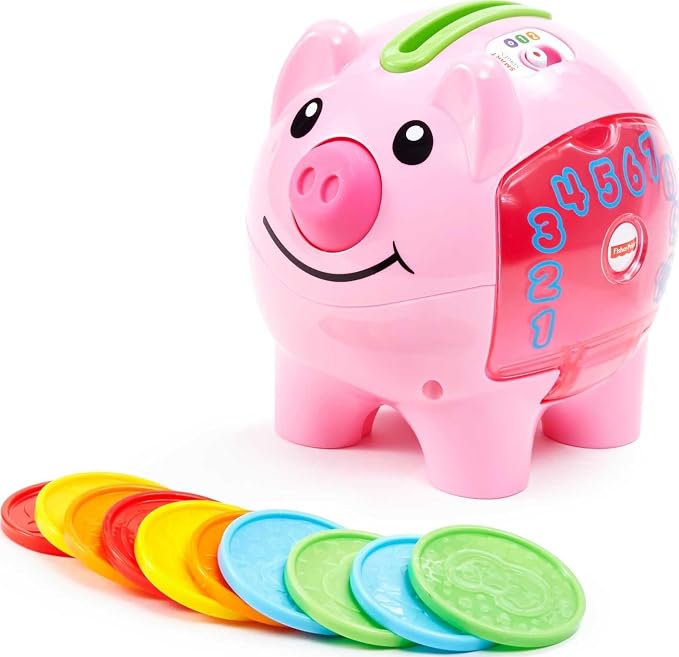
Fisher-Price Laugh & Learn Smart Stages Piggy Bank
This piggy bank gives babies and young toddlers a clear posting sequence: pick up a large coin, guide it toward the slot, release it and retrieve it through the opening. Songs and phrases make it more stimulating than a traditional silent posting box, while the main hand action still comes from the child.
- Confirm every coin is secure and age appropriate
- Inspect the battery compartment
- Use the sound controls when quieter play is preferred
- Supervise children who still mouth objects
What to watch: Follow the current package age marking and stop using the toy if a coin or door becomes damaged.
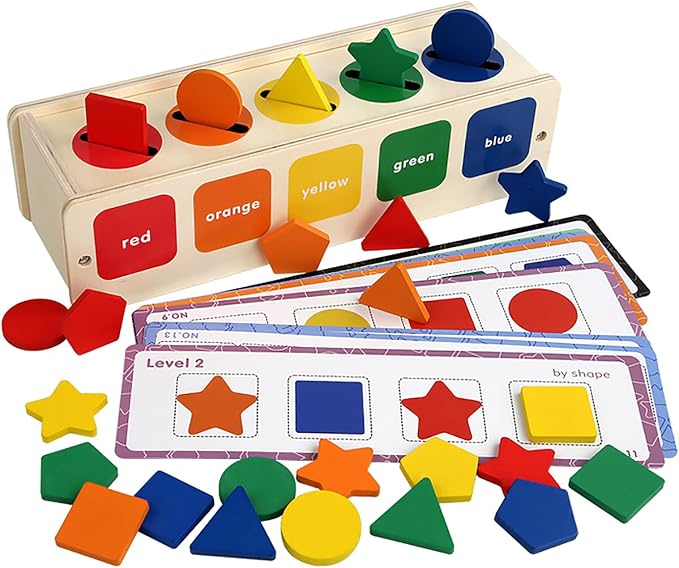
Montessori Wooden Colour and Shape Sorting Toy
This wooden sorter asks the child to grasp a piece, turn it, align it with a post and lower it into place. Colour and shape add matching choices, but the activity can be simplified by offering only one or two pieces at a time.
- Check every piece against the current age grade
- Inspect paint and finish condition
- Use the toy on a stable surface
- Offer fewer pieces when the full set is overwhelming
What to watch: Sorting correctly is not the only worthwhile use. Removing and replacing pieces still provides useful hand practice.

BOHS Caterpillar Lacing Toy
This set includes twenty wooden pieces for threading and stacking. The caterpillar format gives the child a playful reason to guide pieces along a lace while the stacking option provides a second, simpler way to use the set.
- Confirm bead size against the listed age grade
- Inspect the lace and end pieces before play
- Begin with only a few beads
- Keep away from children who still mouth small objects
What to watch: Laces and loose beads require close supervision and careful storage after play.
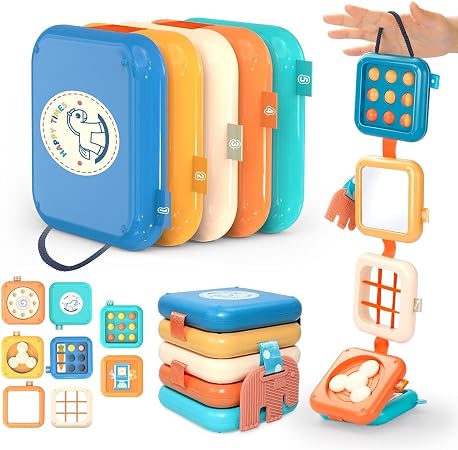
YOLOMOON Montessori Sensory Busy Cube
This soft-sided busy cube packages several hand activities into a compact travel format. Children can pull, turn, fasten and explore different textures without carrying a full-size wooden activity board.
- Inspect every attachment and seam
- Check cords, buckles and fasteners for wear
- Confirm the exact model's age guidance
- Remove the cube if any part becomes loose
What to watch: The supplied title covers a broad age range, so confirm the current listing and package before giving it to a baby.

Wooden Farm Screwdriver Board
This sixteen-piece farm activity gives preschoolers a defined tool task: align the screwdriver, turn a fastener and attach or remove a farm-themed piece. The pictures make the board more inviting without replacing the physical work.
- Use only the supplied child-safe tool
- Count every component before and after play
- Check fasteners and wooden edges for wear
- Store all loose parts away from younger siblings
What to watch: The product is listed for ages three and over and contains multiple pieces. It is not suitable for a younger child simply because it appears in a fine-motor guide.
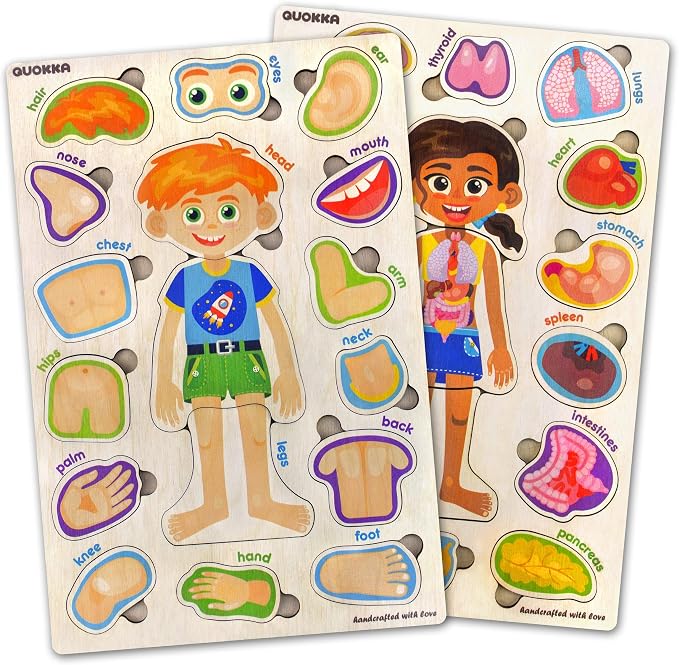
Two-Piece Wooden Montessori Toddler Puzzle Set
This two-board set asks children to grasp a piece, turn it and fit it into a matching space. Two puzzles provide variety, while adults can keep one board stored until the first feels familiar.
- Confirm the listed age for the exact set
- Inspect every piece and attachment
- Offer one board at a time
- Increase the number of pieces gradually
What to watch: Do not force a particular finger grip. Different functional grasps can still allow successful placement.

14-Piece Wooden Sensory Bin Tool Set
This set includes tongs, spoons, bowls and other tools that can be used for scooping, carrying, squeezing, pouring and transferring. The variety makes it easy to adjust the activity without buying separate fine-motor kits.
- Use only age-appropriate sensory materials
- Count all fourteen tools after play
- Inspect tongs and wooden edges
- Keep fillers away from children who mouth objects
What to watch: The tools do not make every sensory-bin filler safe. Avoid water beads and other hazardous small materials, and supervise the entire activity.
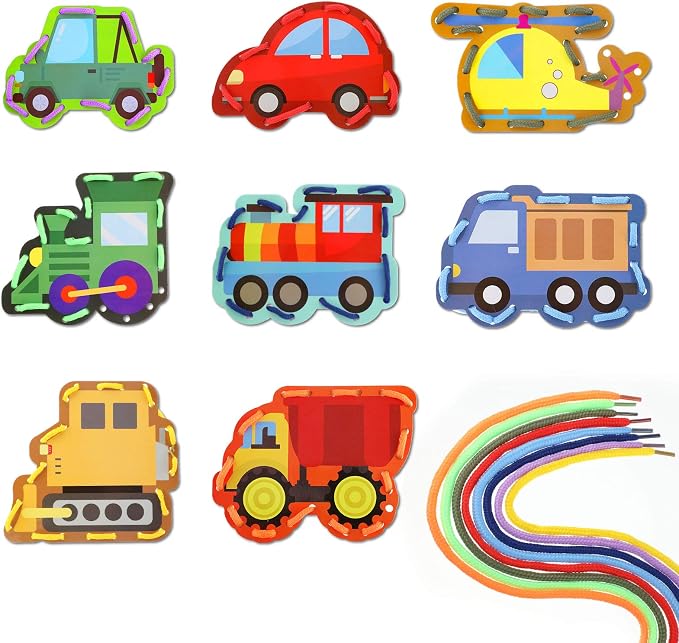
Zonon Transportation Lacing Cards
This eight-card set uses transportation pictures to turn repeated in-and-out lacing into a recognisable activity. A child can work around one card at a time rather than sorting through the complete set.
- Begin with the simplest card shape
- Inspect every lace and card edge
- Check cord length and end pieces
- Follow the current age guidance
What to watch: Lacing cards should be stored with their cords and used under supervision. Stop if a lace frays or an end piece loosens.
Fine-motor toys often include small pieces, cords and hardware
That makes the exact product age grade especially important.
Australian Government toy-safety guidance
Product Safety Australia publishes guidance for children's toys and a mandatory standard for toys intended for children up to and including 36 months. Pegs, beads, discs, bolts and transfer pieces need particular attention because they may be small or detachable.
Inspect cords, tools and hardware
Lacing cords should be age-appropriate and in good condition. Busy boards and screwdriver sets should have secure hardware. Remove any toy with loosened fasteners, broken wooden pieces or parts that can detach unexpectedly.
What the evidence supports about fine-motor play
The strongest claims are simple: children need repeated opportunities to manipulate objects, use their hands and practise everyday actions.
Play provides opportunities for active hand use
The American Academy of Pediatrics describes play as important for development and caregiver-child interaction. Fine-motor toys can fit within active play, but no single product guarantees improved handwriting, concentration or cognitive ability.
Montessori emphasises purposeful handwork
Original Montessori writing places strong emphasis on purposeful activity, practical life and the child's active use of materials. That supports hands-on work without requiring modern neuroscience claims.
Montessori education evidence is broader than toy evidence
Research on Montessori programs evaluates the wider educational environment and method. It does not establish that a specific peg board, puzzle or tweezer set independently produces fine-motor gains.
What this page can responsibly evaluate
ToyBloom can compare hand actions, adjustability, construction, piece size and age fit. It should avoid claiming that a product directly forms brain pathways, creates pencil grip or develops specific muscle groups better than other toy materials.
Fine-motor development varies widely. A child's grasp can look different from another child's and still be functional. If hand use, asymmetry or motor development is a concern, a general toy guide cannot replace individual advice from a qualified health professional.
How to choose a fine-motor toy
Use these six checks before comparing brands.
1. Identify the hand action
Choose one clear movement such as posting, turning, threading, squeezing or lacing.
2. Match resistance to the child
A latch that is too stiff or tweezers that are too hard to squeeze make the task difficult for the wrong reason.
3. Check piece size
Fine-motor toys often use small components. Follow the exact product age grade, especially for children who mouth objects.
4. Use both simple and practical tasks
Puzzles and pegs build controlled placement, while zips, latches and tools connect more directly to everyday hand use.
5. Avoid forcing a specific grip
Functional control matters more than making a toddler hold every object in a textbook-style grasp.
6. Stop treating toys as handwriting training
Fine-motor play is useful on its own. Handwriting develops through a much broader set of experiences.
Frequently asked questions about fine-motor toys
Direct answers without handwriting or neuroscience overclaims.
What are fine motor skills?
Fine motor skills involve controlled movements of the hands and fingers. They are used for grasping, releasing, turning, threading, fastening, drawing and using small tools.
What toys are good for fine motor practice?
Posting boxes, peg boards, lacing beads, busy boards, screwdriver boards, knob puzzles, tweezer-transfer sets and lacing cards are all useful options.
When does the pincer grip develop?
A pincer-like grasp commonly emerges during later infancy, but timing varies. Toys should not be used as developmental tests.
Do fine motor toys prepare children for handwriting?
They provide useful hand practice, but no single toy directly produces handwriting readiness. Handwriting depends on broader motor, visual, language and learning experiences.
Are wooden toys better for fine motor skills than plastic toys?
No. Material alone does not determine fine-motor value. Task design, age fit, safety and active use matter more.
Should I correct how my toddler grips a toy?
Usually the goal is functional control, not forcing one perfect grip. If you are concerned about hand use or motor development, seek individual professional advice rather than correcting every grasp during play.