
Best Montessori Toys for Cognitive Development in Toddlers
Cognitive development is a broad term. For a toy guide, the most useful approach is to focus on what a child actually does: compare, match, rotate, sequence, balance, test, notice an error and try again.
Four kinds of thinking these toys can invite
These are play opportunities, not guarantees of cognitive improvement.
Which shape, cylinder, colour or pattern belongs here?
Will this fit through, inside, on top or next to something else?
What has to happen first before a latch, maze or pattern can be completed?
How do separate pieces combine into one complete form?
Control of error: useful feedback built into play
In Montessori-style play, the material can help a child notice a mismatch and try again without constant adult correction.
What control of error means
- The material gives feedback without constant adult correction.
- A shape does not fit the wrong opening.
- A cylinder placed in the wrong socket leaves another cylinder unmatched.
- A balance tips when the two sides differ.
- The child can notice the result and try a different action.
What it does not prove
- That the toy strengthens a specific brain region.
- That pincer grip drives executive function.
- That wood is cognitively superior to plastic.
- That a child will develop maths skills faster.
- That every mistake must be solved independently without adult support.
The 8 cognitive-play picks at a glance
These real products cover visual logic, patterns, balance, mechanical problem-solving, shape matching, construction, classification and sequencing. Choose the challenge that fits the child rather than buying every category.
| Pick | Best for | Age guidance | Before buying |
|---|---|---|---|
| SMART Safari Animals | Visual logic and orientation | Confirm current listing | Check piece size |
| Pattern blocks and smart sticks | Patterns and spatial planning | Ages 3 to 5, per supplied title | Store small pieces securely |
| PlanToys Timber Tumble | Balance and prediction | Confirm current listing | Inspect wood and finish |
| Farm screwdriver board | Sequence and mechanical problem-solving | Ages 3+, per supplied title | Count every component |
| Coogam colour-shape puzzles | Colour, shape and placement | Ages 3 to 5, per supplied title | Confirm piece dimensions |
| Interlocking building blocks | Construction and revision | Confirm current listing | Check small-piece suitability |
| Dinosaur counters | Sorting and classification | Ages 3 to 5, per supplied title | Keep away from younger children |
| Elite ball tracker | Tracking and sequence awareness | Confirm current listing | Check frame stability |
8 Montessori-style toys for cognitive play
Each pick is assessed for task clarity, physical feedback, adjustable difficulty, safety and whether the child controls the action.
The child can understand what they are trying to fit, match, move or balance.
The material shows when something does not fit or balance.
You can reduce pieces, shapes, steps or variables.
Piece size, removable hardware, construction and age grading come before educational claims.
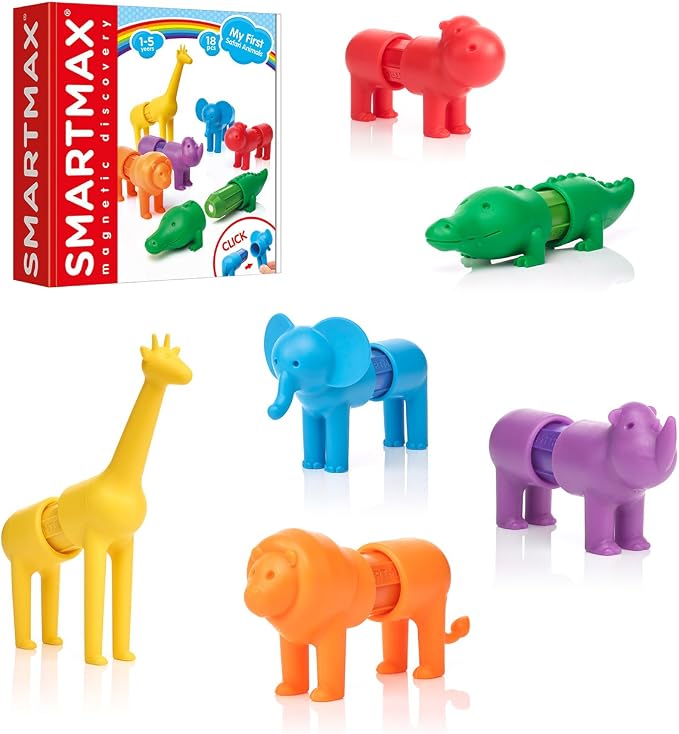
SMART Games My First Safari Animals
This compact activity asks the child to place and orient animal pieces to match a visual challenge. The figures can also be used for sorting and simple animal stories.
- visual logic
- orientation
- problem-solving
- active child participation
Why it can work: The child compares positions, tests an arrangement and checks whether every animal fits. Graded challenges make the difficulty easier to adjust.
Safety check: Confirm the current age grade and piece dimensions. Keep all pieces together and remove any damaged component.

142-Piece Wooden Pattern Blocks and Smart Sticks
Pattern blocks and sticks can be copied from a model, rotated into a new arrangement or combined into original pictures and structures.
- patterns
- rotation
- planning
- active child participation
Why it can work: The child compares shapes, plans placement and revises pieces that do not fit. The same set can move from free design to more structured challenges.
Safety check: Confirm the age grade and piece size. Store the many small components securely and keep them away from younger children.

PlanToys Timber Tumble
Each move asks the child to predict where a wooden piece can sit, place it carefully and observe whether the structure remains stable.
- balance
- prediction
- revision
- active child participation
Why it can work: The physical result is clear. A stable stack or tumble gives feedback that supports another attempt without needing a score.
Safety check: Confirm the current age guidance and piece dimensions. Stop using pieces that develop cracks, splinters or damaged finishes.

Wooden Farm Screwdriver Board, 16 Pieces
The child must steady the board, align a fastener and turn the tool in the correct direction. The farm scene adds a visible place for every removable piece.
- tool use
- sequence
- matching
- active child participation
Why it can work: The task combines order, direction, matching and two-hand coordination while giving a clear visible result.
Safety check: Count every component after play. Inspect the tool and fasteners, and store the set away from younger children.
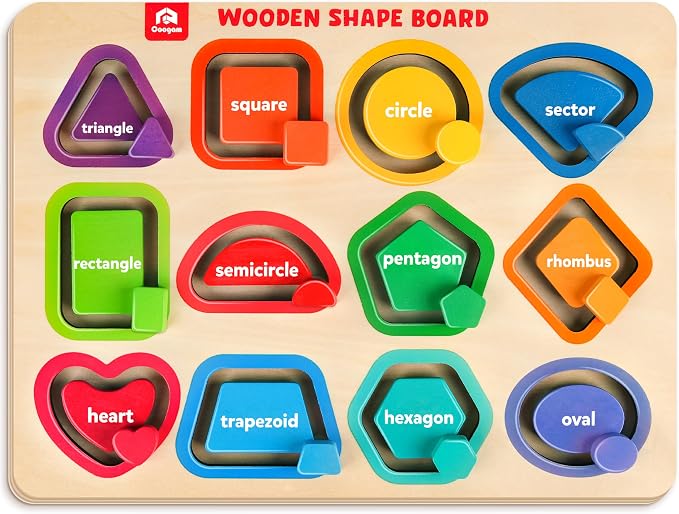
Coogam Wooden Colour Shape Puzzles
This set asks the child to compare colour, shape and position before fitting pieces into an arrangement. The task can be simplified by offering one board or fewer pieces.
- colour
- shape
- placement
- active child participation
Why it can work: The board provides a clear problem and finish point while the loose pieces also support sorting and pattern making.
Safety check: Confirm the current age grade and piece size. See ToyBloom’s colour-sorting guide for a deeper comparison of this play type.
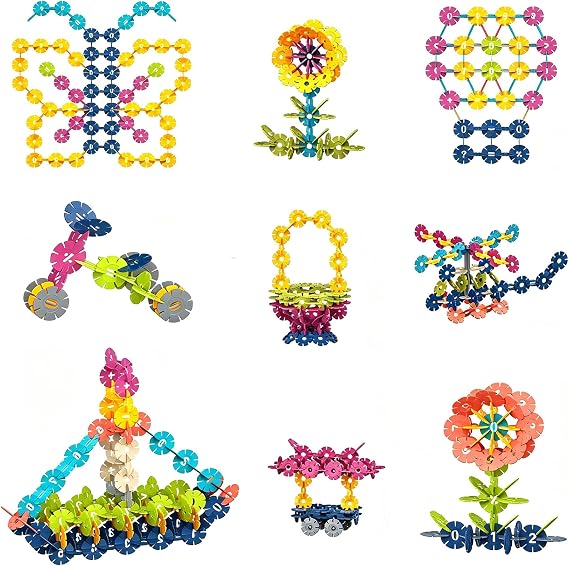
240-Piece Interlocking Building Blocks
Interlocking pieces require the child to compare connection points, test stability and revise a structure that does not work as planned.
- construction
- testing
- revision
- active child participation
Why it can work: The set allows many solutions instead of one correct model, so planning can become more complex as the child’s building changes.
Safety check: The set contains many small pieces. Confirm the current age grade and dimensions, and keep all components away from younger siblings.

48-Piece Colour Sorting and Counting Dinosaurs
Dinosaur counters can be grouped by colour, type or an invented rule. They can also be lined up, counted or used as characters after the sorting task.
- classification
- counting
- rule changes
- active child participation
Why it can work: Classification asks the child to notice shared features and apply a rule. Changing the rule prevents the activity from becoming one fixed answer.
Safety check: These are small loose pieces. Follow the current age grade and store them securely away from younger children.

Elite Montessori Ball Tracker
A ball tracker creates a repeatable sequence: release a ball, follow its path and retrieve it at the bottom. The child can compare what happens with each coloured ball.
- tracking
- sequence
- cause and effect
- active child participation
Why it can work: The predictable path supports visual tracking and sequence awareness while the child controls the beginning of each trial.
Safety check: Confirm the current age grade and ball size. Check the wooden frame and rails for stability, loose parts or damage.
Australian safety guidance
Cognitive toys can contain small pieces, wooden components, tools, fasteners and other removable parts.
General toy checks
Product Safety Australia publishes guidance for children's toys and a mandatory standard for toys intended for children up to and including 36 months. Use the exact product age grade and inspect detachable pieces carefully.
Kids' toys guide
Mandatory standard for toys up to 36 months
Product recalls
Small pieces and removable hardware
Count loose pieces after play, inspect wooden parts for cracks or splinters, and stop using any toy with damaged fasteners or components that can detach. Keep toys intended for older children away from younger siblings, and check the current product listing and packaging for age guidance.
What the evidence supports
The strongest claims are about opportunities for active play, not about one retail toy causing measurable gains in executive function or maths.
Play involves active problem-solving
The American Academy of Pediatrics describes play as important for development and caregiver-child interaction. Toys that invite matching, testing and rebuilding can fit within active play, but no individual toy guarantees cognitive gains.
Montessori materials use order and physical feedback
Montessori writing emphasises carefully designed materials, sensory discrimination, purposeful activity and independence. Control of error is a useful design principle, but it does not require modern brain-imaging claims to be valuable.
Montessori program evidence is broader than toy evidence
Research on Montessori education evaluates a learning environment and method. It does not show that a specific puzzle, sorting set or ball tracker independently improves executive function.
What this page can responsibly evaluate
ToyBloom can compare task clarity, feedback, adjustability, construction, piece size and age fit. It should avoid claims that fine-motor action directly drives working memory, spatial reasoning or prefrontal development.
How to choose a cognitive-play toy
Fit, match, balance or move. Avoid toys that combine too many rules at once.
A mismatch should be visible or physical without needing constant adult correction.
Offer fewer shapes, one latch or one puzzle level first.
Prior experience can matter as much as age.
Inspect pieces and hardware regularly, and follow the exact product guidance.
Talk about heavier, lighter, same, whole, half, more or fewer before introducing formal symbols.
Related ToyBloom guides
Frequently asked questions
Direct answers without neuroscience or executive-function overclaims.
What is control of error in Montessori materials?
Control of error means the material itself gives feedback that helps the child notice a mismatch or mistake. For example, if a cylinder is placed in the wrong socket, another cylinder may no longer fit.
Do fine motor toys directly improve cognitive development?
Hands-on play can involve planning, comparison and problem-solving, but a toy should not be presented as directly activating specific brain pathways or guaranteeing executive-function gains.
At what age should toddlers start shape sorters?
There is no single age. Start when the child is interested in posting objects and can handle the pieces safely. Simplify the sorter by offering fewer shapes when needed.
Are wooden Montessori toys better than electronic toys for cognitive development?
Not automatically. A simple electronic toy can be useful and a poorly designed wooden toy can be frustrating. Task clarity, safety, age fit and active child participation matter more than material alone.
Do Montessori toys teach early maths?
Some materials create opportunities to compare size, weight, quantity, order and part-to-whole relationships. Those are useful experiences, but they should not be presented as a guarantee of later mathematical achievement.
What if my toddler keeps using trial and error?
Trial and error is a normal part of problem-solving. If the task is too difficult, simplify it rather than correcting every attempt.